
Do Not Run Google Ads Until Your Contractor Website Has These Things
A practical checklist for contractors to review before spending money on Google Ads or paid traffic.
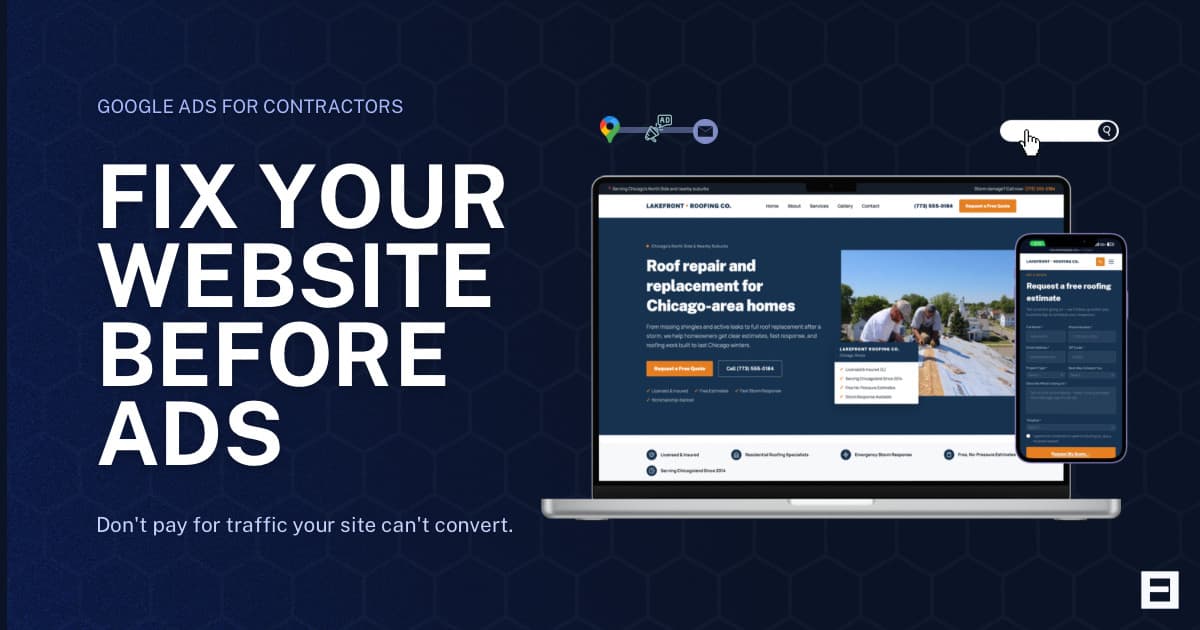
Google Ads can be useful for contractors, but paid traffic will not fix a weak website.
If someone clicks your ad and lands on a page that is slow, vague, hard to use on mobile, or missing proof, the ad may have done its job. The website did not.
Before you spend money sending more people to your site, make sure the site is ready to turn that traffic into real calls, quote requests, or booked estimates. This is not a Google Ads setup guide. It is a contractor website checklist to review before you start paying for clicks.
Contractor website note: Paid traffic does not fix an unclear website. It usually makes the weak spots easier to see.
Quick Answer: What Should a Contractor Website Have Before Google Ads?
Before running Google Ads, your contractor website should have the basics in place:
- A clear service offer
- A clear service area
- A mobile-friendly layout
- Fast-loading pages
- Visible phone and quote buttons
- Real project photos
- Reviews, testimonials, or trust proof
- A simple quote form
- A page that matches the ad
- Basic tracking for calls and forms
Google Ads explains that landing pages should be relevant, useful, and connected to the ad's call to action. That means the website matters before the campaign ever goes live. source: Google Ads Help, Optimize your ads and landing pages
If your contractor website is confusing, thin, or hard to use, Google Ads can send you more visitors without solving the real issue.
Why Google Ads Expose Contractor Website Problems Fast
Referral traffic is different from paid traffic.
When a homeowner gets your name from a neighbor, friend, or past customer, they may already trust you before they visit your website. They are usually checking your site to confirm what they already heard.
A Google Ads visitor is colder. They may be comparing three or four contractors at the same time. They may have never heard of your business before. They may be on a phone, in a hurry, trying to solve a problem.
They are asking questions quickly:
- Do you offer the service I need?
- Do you work in my area?
- Do you look legitimate?
- Have you done this kind of work before?
- How do I call or request a quote?
If your website does not answer those questions clearly, the visitor may leave and click the next company.
A paid click gets someone to your site. It does not make them trust you.
For example, imagine a homeowner searches for "emergency roof leak repair near me." They click an ad, then land on a generic homepage that says "quality exterior solutions" but does not mention roof leaks, emergency work, service areas, reviews, or a phone number near the top.
That is not just a design problem. It is a paid traffic problem.
If you want to see what a cleaner contractor site structure can look like, view FutureBuilt's example contractor website.
The Contractor Website Google Ads Readiness Checklist
Before you run Google Ads for a contractor business, review these website essentials.
1. A Clear Service Offer
The first thing a visitor sees should make the service obvious.
A contractor website should not make people decode what the business does. Avoid vague phrases like:
- Quality solutions
- Full-service experts
- Exterior specialists
- Property improvement professionals
Those phrases may sound polished, but they do not help a homeowner confirm that you handle their specific problem.
Better headlines are direct:
- Roof Leak Repair in Chicago
- AC Repair and Installation in Oak Park
- Kitchen Remodeling for Chicago Homes
- Concrete Patio Installation in the Western Suburbs
- Pressure Washing for Driveways, Siding, and Patios
Google's SEO Starter Guide recommends creating useful content for people and helping search engines understand what the page is about. For contractors, that starts with using plain service language in important places like page titles, headings, and body copy. source: Google Search Central, SEO Starter Guide
That advice matters for ads too. If someone clicks an ad for AC repair, the landing page should clearly say AC repair.
2. A Clear Service Area
A contractor website should quickly tell visitors where the company works.
This sounds basic, but many local service websites either hide the service area or list it in a way that feels confusing. A homeowner should not have to wonder whether you serve their town.
A simple line can help:
Serving Chicago, Oak Park, Evanston, Skokie, and nearby suburbs.
Clear service areas help visitors self-qualify. They also reduce wasted inquiries from people too far outside your market.
For contractors serving Chicagoland, service-area clarity should be part of the website structure from the start. FutureBuilt builds contractor websites for Chicago-area service businesses with clear services, local trust signals, and quote paths.
3. A Mobile-Friendly Layout
Many paid visitors will be on a phone. If your website is hard to use on mobile, your ads are sending traffic into friction.
A mobile-ready contractor website should have:
- A phone number that is easy to tap
- A quote button that is easy to find
- Text that is readable without pinching and zooming
- Images that do not crush the layout
- A form that works on a small screen
- Important service information visible without digging
Mobile accounted for 52.8% of worldwide desktop, mobile, and tablet web traffic in April 2026. source: StatCounter Global Stats
Google Ads also gives advertisers landing page reporting that includes mobile-friendly click rate. source: Google Ads Help, Evaluate the performance of your landing pages
For contractors, mobile usability is not a minor design detail. A homeowner with a leaking roof, broken AC, clogged drain, or damaged driveway may be comparing options from their phone. If your site makes that difficult, they may not wait.
4. Fast Page Load
A slow contractor website creates friction before the visitor even reads your offer.
Common causes include:
- Oversized project photos
- Heavy sliders
- Too many plugins
- Bloated page builders
- Large background videos
- Tracking scripts added without cleanup
Google research found that as mobile page load time went from 1 second to 10 seconds, the probability of a mobile visitor bouncing increased 123%. The same research found that as the number of page elements increased from 400 to 6,000, conversion probability dropped 95%. source: Think with Google, New Industry Benchmarks for Mobile Page Speed
You do not need a bare-bones website. You do need a site that loads fast enough for real people on real phones.
Contractor website note: A visitor who clicks an ad and waits too long may never see your services, photos, reviews, or quote button.
5. Obvious Call and Quote Buttons
Once a visitor decides to contact you, the next step should be obvious.
Do not hide the phone number in the footer. Do not rely on one small "Contact" link in the menu. Do not make visitors scroll through the whole page before they know how to request a quote.
Use clear CTA labels:
- Call Now
- Request a Quote
- Schedule an Estimate
- Get a Free Estimate
- Ask About This Service
For most contractors, the main conversion path is simple: call, form, or quote request. Make that path easy.
You can send visitors directly to a clear quote path with a page like Request a Quote.
6. Real Project Photos
Real project photos help prove that your company does the work you claim to do.
Stock photos can look clean, but they often feel generic. A homeowner has likely seen the same polished photos on other contractor websites. Real photos show your actual jobs, crew, trucks, process, materials, and finished work.
Useful photos can include:
- Before and after photos
- Completed roof, HVAC, remodeling, or concrete projects
- Crew photos
- Branded trucks or equipment
- Jobsite photos
- Close-ups of materials or workmanship
A pressure washing company showing a real driveway before and after may be more convincing than a perfect stock image of a clean patio.
Nielsen Norman Group identifies design quality, disclosure, current content, and connection to the rest of the web as factors that influence website trust. source: Nielsen Norman Group, Trustworthiness in Web Design
7. Reviews, Testimonials, or Trust Proof
Google Ads visitors often do not know you yet. Reviews and trust proof help close that gap.
Strong trust signals can include:
- Google reviews
- Customer testimonials
- Star ratings
- Before and after project examples
- Years in business
- License or insurance notes, where appropriate
- Warranty information
- Photos of real completed work
- Local association memberships
- Recognizable manufacturer or product badges
Do not overload the page with vague claims like "best in the area" or "number one contractor." Specific proof is stronger than generic bragging.
BrightLocal's 2026 Local Consumer Review Survey found that 85% of consumers say positive reviews make them more likely to use a business. source: BrightLocal, Local Consumer Review Survey 2026
A good contractor website does not ask visitors to trust words alone. It shows reasons to believe.
8. A Simple Quote Form
A quote form should help someone start the conversation, not feel like paperwork.
For many contractors, a good starting form asks for:
- Name
- Phone number
- Service needed
- Project location
- Short message
You can always collect more details later. The first goal is to make it easy for a real prospect to raise their hand.
Avoid forms that ask too much too early:
- Exact budget
- Full project timeline
- Too many required dropdowns
- Long property details
- Questions the visitor may not know how to answer yet
Nielsen Norman Group describes forms as mental work and recommends reducing cognitive load through structure, transparency, clarity, and support. source: Nielsen Norman Group, 4 Principles to Reduce Cognitive Load in Forms
A quote form should also work well on mobile. Labels should remain visible, required fields should be clear, and the visitor should know what happens after submitting.
9. A Page That Matches the Ad
Message match is one of the biggest practical issues in Google Ads for contractors.
If your ad says "AC repair," the click should not land on a general HVAC homepage that gives equal attention to heating, cooling, maintenance plans, ductwork, and indoor air quality.
If your ad says "storm damage roof repair," the page should quickly confirm storm damage and roof repair.
Google Ads says landing pages should closely match ad text and keyword themes, and that the landing page should mirror the call to action in the ad. source: Google Ads Help, Optimize your landing page for your Smart campaign
Here is what that looks like in practice:
| Ad promise | Weak landing page | Better landing page |
|---|---|---|
| Roof leak repair | Generic roofing homepage | Roof leak repair page with emergency language, service area, photos, and call button |
| AC repair | HVAC homepage with every service mixed together | AC repair page with urgent service CTA and phone number |
| Kitchen remodeling | General remodeling services page | Kitchen remodeling page with gallery, process, and consultation CTA |
| Pressure washing | Homepage with all exterior cleaning services | Pressure washing page with before and after photos and quote form |
A dedicated landing page is not always required. But the page should match the visitor's intent.
10. Basic Tracking for Calls and Forms
Before you spend serious money on Google Ads, make sure you can tell what is happening after the click.
At a basic level, contractors should know:
- Which forms were submitted
- Which calls came from ads, where possible
- Which pages are getting paid traffic
- Which services are producing real inquiries
- Which leads turned into booked estimates or jobs
Google Ads says website conversion measurement helps advertisers understand what users do after interacting with Google Ads. source: Google Ads Help, Set up your web conversions
Google Ads also provides guidance for measuring calls from ads and tracking calls to a phone number on a website. source: Google Ads Help, Measure calls from ads source: Google Ads Help, Track calls to a phone number on a website
Clicks alone are not enough. A click is traffic. A call, form submission, booked estimate, or qualified lead is closer to what a contractor actually cares about.
Website Elements That Matter Before Ads
Use this table as a quick audit before you run Google Ads or increase your budget.
| Website element | Why it matters before Google Ads | What happens if it is missing |
|---|---|---|
| Clear service headline | Confirms the visitor is in the right place | Visitors may leave or keep comparing |
| Service area | Helps buyers know if you work near them | More unqualified calls or confusion |
| Mobile-friendly layout | Many visitors click from phones | Calls and quote requests become harder |
| Fast load time | Reduces friction after the click | Paid visitors may leave before reading |
| Real project photos | Shows proof of actual work | Site feels generic or unproven |
| Reviews or testimonials | Reduces trust concerns | Homeowners may keep researching competitors |
| Visible CTA | Makes the next step obvious | Visitors may not know how to contact you |
| Simple form | Makes quote requests easier | People may abandon the form |
| Matching landing page | Keeps the ad promise consistent | Visitors may feel they landed in the wrong place |
| Tracking | Helps measure real inquiries | You may judge ads only by clicks |
Planning to run Google Ads?
Make sure your website is ready before you pay for traffic. FutureBuilt builds clean contractor websites designed to make the next step obvious.
Get a Website Quote
The Biggest Contractor Website Mistakes That Waste Paid Traffic
Google Ads can make website problems more expensive because every visitor costs money.
Here are common contractor website mistakes to fix before increasing ad spend.
Sending Every Ad to the Homepage
A homepage can work for broad traffic, but it is often too general for specific ad campaigns.
If someone searches for "tankless water heater installation," they should land on a page that talks about tankless water heaters, not a general plumbing homepage with twenty services.
The more specific the ad, the more specific the landing page should usually be.
Hiding the Phone Number
For many home service businesses, phone calls matter. If the number is hard to find, especially on mobile, you are adding friction right when the visitor is ready to act.
A phone number should be visible in the header, near major CTAs, and on the contact page.
Using Vague Service Descriptions
A service page should explain what you actually do. Do not just list "roofing," "remodeling," or "HVAC."
A better page explains:
- The specific service
- Common problems you solve
- Who the service is for
- Where you provide it
- What the next step looks like
Using Only Stock Photos
Stock photos are not always bad, but a site built entirely from stock images can feel interchangeable.
Contractors should show real work whenever possible. Real project photos help visitors picture the company doing the job at their own property.
Making the Form Too Long
A long form may seem helpful for qualifying leads, but it can also stop people from reaching out.
The form should collect enough information to begin the conversation. It should not feel like a full project intake process unless that is truly necessary.
Forgetting Mobile Visitors
If your desktop site looks fine but the mobile version is hard to use, you still have a problem.
Check the site on an actual phone. Look for:
- Small buttons
- Text that is hard to read
- Forms that are annoying to fill out
- Images that load slowly
- Menus that hide important pages
- Quote buttons that are too far down the page
Not Tracking Calls or Forms
If you are paying for traffic but not tracking results, you may end up judging the campaign by clicks, impressions, or feelings.
Contractors should care about real inquiries. At minimum, track form submissions. If phone calls matter, look into call tracking options.
Contractor website note: If the page cannot convince a referral visitor, it probably will not convince a colder ad visitor.
Not sure what your current website is missing? Contact FutureBuilt and ask for a review.
When a Homepage Is Enough and When You Need a Dedicated Landing Page
A dedicated landing page is not always required. Sometimes a focused homepage can work.
A homepage may be enough when:
- Your business offers one main service
- The ad is broad
- The homepage is clear and focused
- Your service area is obvious
- The phone number and quote button are easy to find
- The page has strong trust proof
A dedicated service page or landing page is usually better when:
- The ad promotes one specific service
- The service is urgent or high-value
- The homepage covers too many different services
- The visitor needs specific proof
- The ad promise needs a tighter match
For example, a roofer running ads for storm damage roof repair should usually send visitors to a roof repair or storm damage page, not just a general roofing homepage. FutureBuilt's roofing website work is focused on helping roofers show services, proof, and quote paths clearly. Learn more about Chicago roofing websites.
The same idea applies to HVAC. If an HVAC company runs ads for AC repair, the visitor should not have to dig through furnace installation, maintenance plans, indoor air quality, and duct cleaning before finding cooling repair. A focused HVAC site can make those service paths clearer. See FutureBuilt's page for HVAC websites.
What Homeowners Need to See Before They Call
Homeowners are not only buying a service. They are choosing who they feel safe inviting onto their property.
Before they call, they usually need to see:
- The service they need
- The area you serve
- Signs that your business is legitimate
- Proof that you have done similar work
- Reviews or testimonials
- Clear contact information
- An easy next step
BrightLocal's 2026 Local Consumer Review Survey shows that local buyers use reviews to evaluate businesses before choosing who to contact. source: BrightLocal, Local Consumer Review Survey 2026
Nielsen Norman Group's trust research also supports the idea that users evaluate credibility before they take action. source: Nielsen Norman Group, Trustworthiness in Web Design
For contractors, trust is practical. It is not just about looking polished. It is about answering the doubts that keep someone from calling.
A homeowner may wonder:
- Will they show up?
- Do they know this type of work?
- Are they local?
- Are they legitimate?
- Will they pressure me?
- Can I get a quote without a hassle?
Your website should reduce those doubts before the visitor reaches the contact form.
How to Know If Your Site Is Ready for Google Ads
Before launching Google Ads, answer these questions:
- Can a visitor understand your main service within a few seconds?
- Is your service area clear?
- Is your phone number easy to find on mobile?
- Is there a clear quote request button near the top?
- Do you show real project photos?
- Do you show reviews, testimonials, or trust proof?
- Does your form work well on a phone?
- Does each ad point to a relevant page?
- Does the page load quickly?
- Can you track calls or form submissions?
If you answer "no" to several of these, fix the website before raising ad spend.
That does not mean you need a huge website. Many contractors need a clean, focused site with clear pages, real proof, and a simple quote path.
Final Recommendation
Google Ads can be useful for contractors and local service businesses. But ads are not a replacement for a clear, trustworthy website.
Before you buy more clicks, make sure the site is ready to receive them.
Your website should quickly show what you do, where you work, why someone can trust you, and how they can request a quote. It should work well on mobile, load quickly, and match the promise made in your ad.
A stronger website does not guarantee better ad results, but it gives paid traffic a better place to land.
Need a contractor website that actually helps people trust you?
FutureBuilt Digital builds clean, mobile-friendly websites for contractors and local service businesses, built to turn visitors into quote requests.
Related guides
Contractor Websites 7 min read
The Contractor Website Checklist: 12 Things Your Site Needs to Turn Visitors into Leads
If your website is missing any of these 12 things, it may be costing you calls and quote requests every week. A practical guide for contractors.
Read the articlearrow_forwardContractor Websites 6 min read
How Much Should a Contractor Website Cost?
A practical guide for contractors comparing cheap website builders, freelancers, agencies, and custom-built service business websites.
Read the articlearrow_forwardContractor Websites 7 min read
How Your Contractor Website Supports Your Google Business Profile
Learn how a contractor website supports your Google Business Profile by building trust, clarifying services, and making quote requests easier.
Read the articlearrow_forward