Skip to content

Future Built Digital · Software & systems consultancy

We build the missing systems between your people, software and data.

Leads that stall in a shared inbox. Orders checked across three tools. Reports rebuilt by hand every Monday. We connect the systems you already run, automate the work between them, and build custom software and AI where off-the-shelf tools stop fitting.

10+ years

Building and leading software delivery

Enterprise delivery experience

60+ solution types · 40+ industries · systems built for complex operations

Public, fixed pricing

See engagements →

What we fix

If your team copies it, chases it or re-types it, a system is missing.

Most projects start in one of four places. Each can stay small, or grow into a larger system once the surrounding work needs it.

Slide 1 of 4: Automate a workflow

Automate a workflow

The same people spend part of every day moving information from one place to another.

We take a repeated process with clear rules (routing, handoffs, follow-ups, recurring reports) and make it run on its own, logged, with a person alerted when something fails.

New-customer setup (folder, project, tasks) · Scheduled reports to email or Slack · Orders synced to accounting · Appointment reminders

Talk through a workflow →
Web inquiryEmailExisting accountValidate + assignin order · fallbackTerritory ownerAccount ownerReview queue

We also build reporting and data layers, web platforms connected to the systems behind them, and AI-native products from the ground up. Explore all solutions →

Selected work

Systems we've designed and built, with the reasoning shown.

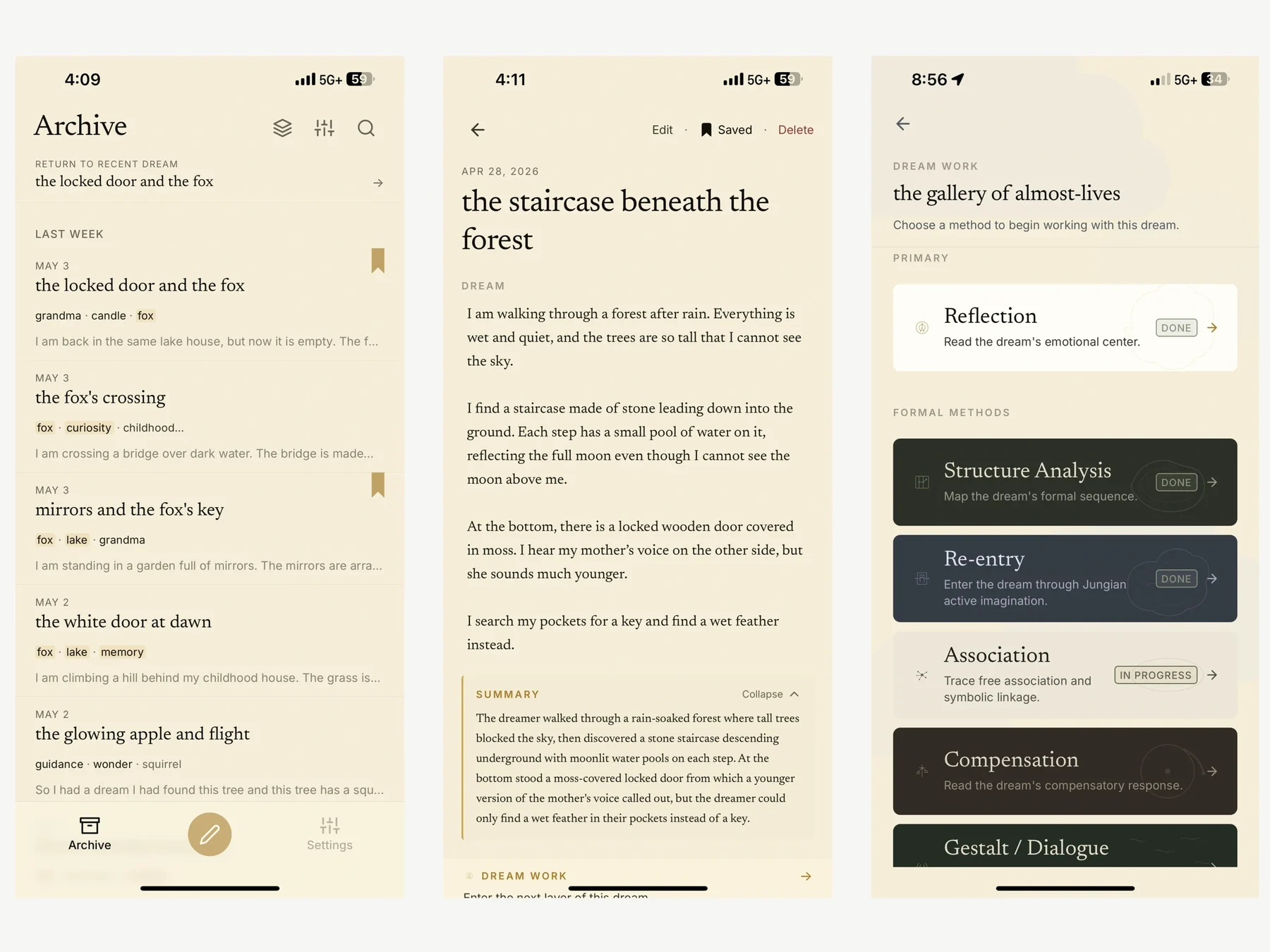
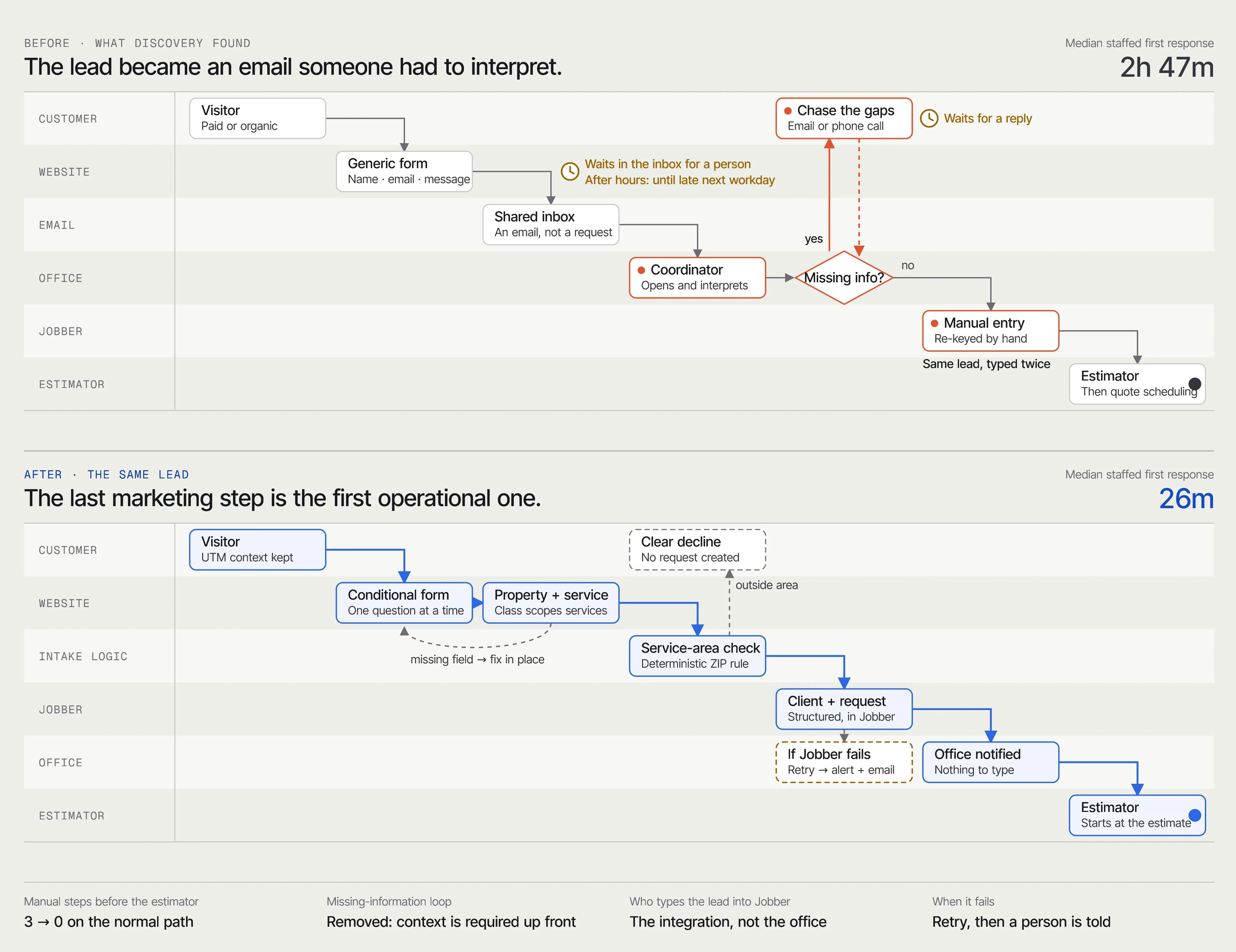
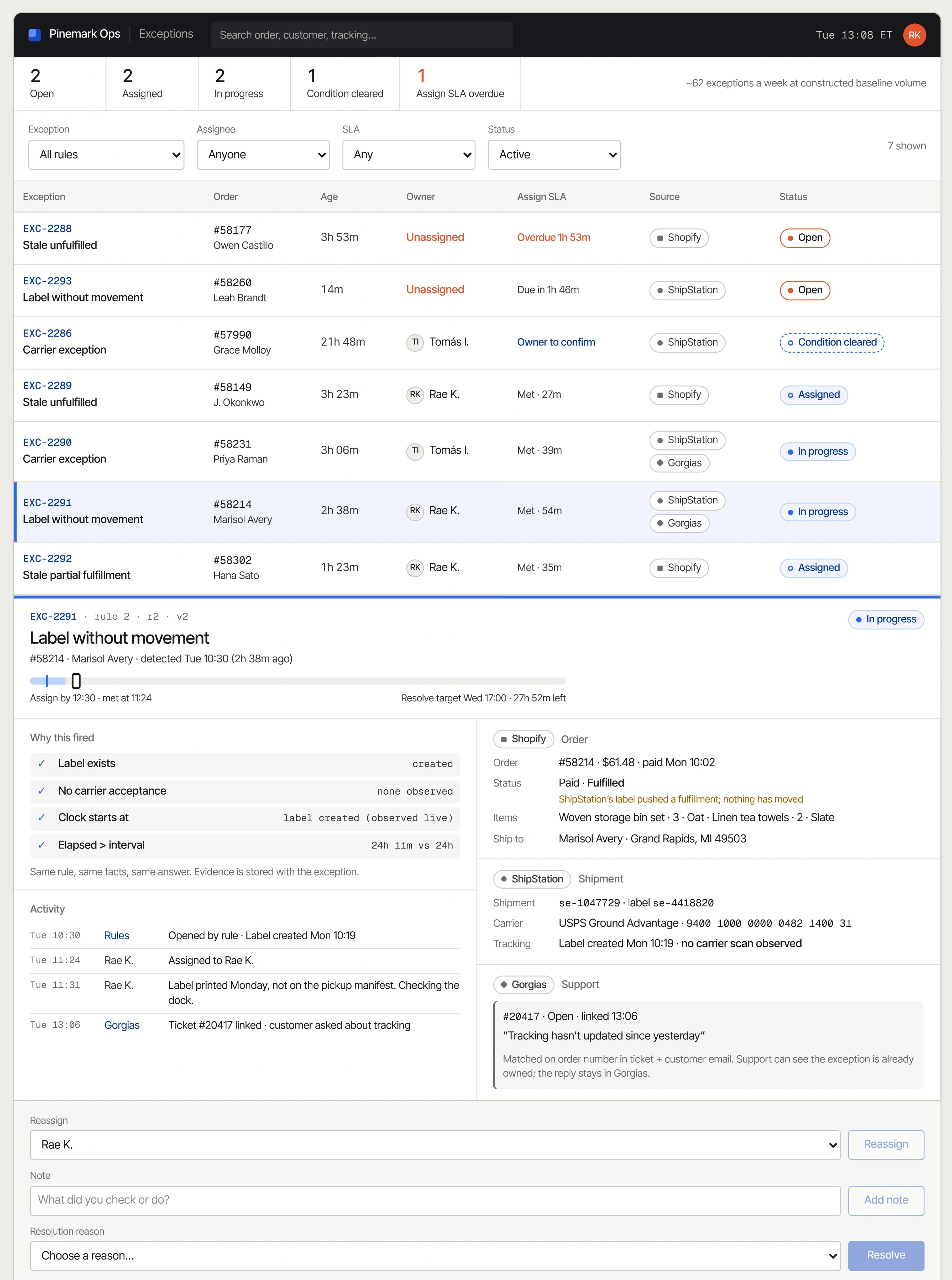
Lead intelligence, document intake, native AI products and connected operations. Explore the systems, the decisions behind them, and the attention to detail that makes them useful.

How we build

Automation is easy to demo. These are the decisions that make it hold up.

Three decisions we make on every project, and where you can see each one in the work above.

Decide what not to automate

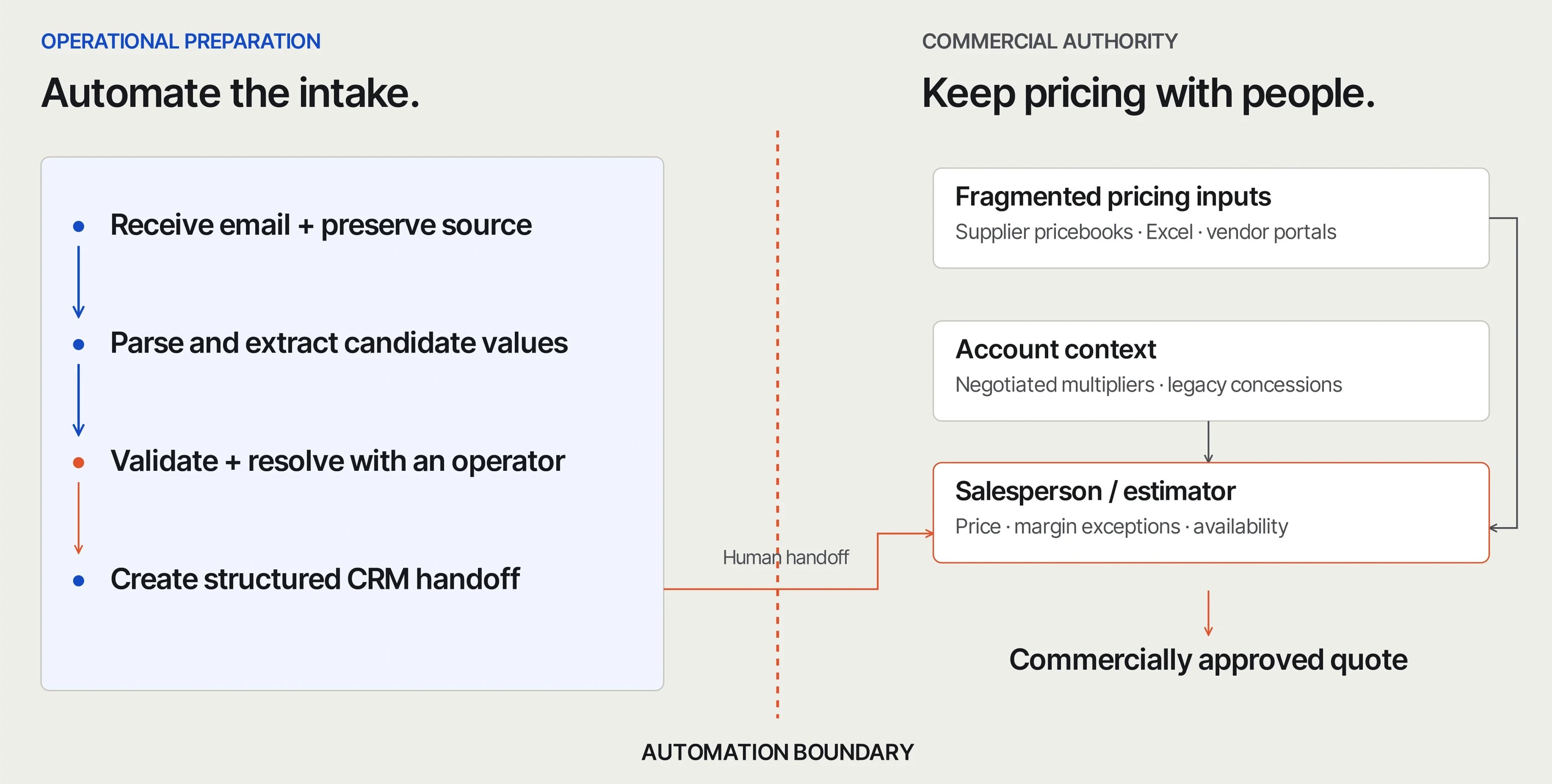
Before building, we draw the line between what software should do and what people should keep. Models handle reading and classifying; rules, validation and approvals stay wherever a wrong answer costs money.

See the automation boundary in Norwyn →

Build for the day something goes wrong

Retries, duplicate prevention, logs, alerts and a human review path are part of the first build. A failed step is recorded and recoverable, not silently skipped.

See how Velum handles failed AI responses →

Hand over something you can run without us

Where practical, production systems run in accounts you control. You receive the code, documentation, credentials and admin access for what we built. Ongoing support is optional, from $100 a month.

IP & code ownership →
See our full approach →

How the work connects

One connected practice.

A business problem rarely belongs to one service. Each industry draws on several solutions, and each solution is built from capabilities shared across the practice. Select any point to trace its connections.

Use the arrow keys to move between items, Escape to clear, and plus or minus to zoom. Details for the selected item follow the map.

  • Industry
  • Solution
  • Capability

Tap any point to see what it connects to.

Browse everything: industries · solutions · capabilities

Your existing systems

Keep the software that works. We build what's missing around it.

Usually the CRM, accounting platform or field-service tool is fine. What's missing is anything that owns the work between them. We decide which system owns each record, connect the rest to it, and add custom software only where a gap remains.

Systems you already run

  • HubSpotCRM
  • ShopifyEcommerce
  • QuickBooksAccounting
  • JobberField service
  • SlackCommunication
  • Google WorkspaceOffice
  • PostgreSQLData

Future Built layer

Owns the work between your systems.

  • Integrations
  • Business rules
  • Validation
  • Work queues
  • Orchestration
  • AI where reading helps
  • Human review
  • Run logs

What your team gets

  • A qualified lead reaches its owner
  • An order exception becomes owned work
  • The weekly report stays current on its own
  • Customer records stay in sync

We confirm each platform’s API access and account limits during discovery, and choose the tools around the work.

Dakota Kronberger, founder of Future Built Digital.

Who builds it

The person who scopes your project is the person who builds it.

Future Built is led by Dakota Kronberger, who spent the decade before founding it as a software engineer, development manager and managing consultant. He runs discovery, designs the architecture and builds the system, so what's agreed in the first session is what ships.

Founder prior experience: work done before Future Built, for other organizations.

  1. Software engineer at a national data organization.
  2. Senior developer, then development manager in an enterprise consulting practice. Code reviews, architecture decisions, estimation, and partial ownership of hiring and performance reviews for a ~12-person team.
  3. Managing consultant on a Fortune 500 manufacturer's digital retail platform. Led a ~20-person onshore and offshore delivery team, owned trade-in, financing and digital-garage workflows, and helped lead delivery as participating locations grew from ~95 to 600+. Reworked the location launch process from 4–5 hours of coordination to about one.
  4. Now: Future Built.
  • Architecture tradeoffs are written down and explained in plain language before anything is built.
  • Delivery habits from enterprise work (estimation, QA, UAT, release readiness, production support) applied at small-business scale.
  • No account manager between your question and an answer.

Engagements and pricing

Start with one process. Build the system around it once it proves out.

Prices are public and fixed for the standard scope. If your project goes past a package, we tell you before work starts and quote the next package, not a stack of add-ons.

Focused build

$812–$2,275

One workflow, integration, report or AI task with a clear boundary.

Typical delivery: 3 business days to 2 weeks

  • Small Process AutomationOne repeated workflow across up to ~3 systems$812
  • Live Reporting DashboardOne live dashboard from up to 3 sources$1,300
  • AI AgentOne bounded job with approval gates and logging$1,625
  • CRM & System IntegrationTwo or more systems kept in step$1,950
  • Document & Inbox AutomationOne document family, extracted and validated$2,275

Connected workflow

from $3,250

A process that spans several systems, states and approvals, or related automations run and monitored together.

Typical delivery: 2–6 weeks

  • Advanced Process AutomationThree to six systems, approvals and an exception queuefrom $3,250
  • Automation SuiteAbout three workflows sharing one admin viewfrom $5,525

Custom business system

from $7,800

Software your team works in, when the work has outgrown automation and off-the-shelf tools.

Typical delivery: 4–12+ weeks, in phased releases

  • Operations Control CenterOne interface for work spread across toolsfrom $7,800
  • Custom Business SystemInternal CRMs, client portals, quoting systems, AI productsfrom $9,750

Two ways to define the work

Free Project Roadmap

Free

What should we probably do next? For a problem you can already describe.

A 30-minute conversation about one process. Within 24 hours, a short written recommendation:

  • whether we're a fit
  • the first thing worth fixing
  • the main systems involved
  • the likely engagement and rough price
  • the next step

Architecture Sprint

$1,625 · credited toward the build

Define the project well enough to build it with confidence. For larger or unclear work: legacy systems, unknown APIs, or scope likely above about $10,000.

Paid discovery and design, delivered as:

  • a current-state map and systems of record
  • API and data constraints
  • target architecture and solution boundaries
  • dependencies and major risks
  • acceptance criteria and a phased plan
  • a fixed implementation estimate

Included: production deployment, handoff documentation and launch stabilization: 14 days for focused builds, 30 days for larger systems. Model APIs, hosting and SaaS usage run on your accounts at cost, estimated before launch.

Optional support starts at $100/month. No retainer is required.
Tell us what needs to work better →

How we work

From the first conversation to a system your team runs.

Four phases, scaled to the project. An $812 workflow moves through them in days; a custom system takes weeks and ships in phases.

  1. Diagnose

    We map the current workflow: who touches it, which system holds what, where work waits and where it breaks.

    You receive: A current-state map and a written roadmap.

  2. Design

    We decide what to automate, what stays with people, which system owns each record, and how we'll know it worked.

    You receive: A fixed scope, acceptance criteria and a success measure.

  3. Build + integrate

    We build in working increments against your real systems and sample data, failure cases included.

    You receive: A working version early enough to react to.

  4. Launch + measure

    We deploy, watch it in production, fix launch issues and hand over access and documentation.

    You receive: The system, a runbook, and a comparison against the original baseline.

See our full approach →

Start a project

Start with the problem. We'll work out what to build.

Tell us what needs to work better and what you use today. Four short steps, then a brief you can edit before sending.

Step 1 of 4

What needs to work better?

Where is the problem?

Choose the closest. “Not sure yet” is fine.

FAQ

Questions people ask before starting.

We’re not sure what we need. Where do we start?

With the project brief. Most projects begin as an operating problem, not a specification. We map what happens today and recommend the smallest useful first build, with its price.

How much does a project cost?

Prices are public. Focused packages run $812–$2,275. Full-process automation starts at $3,250, automation suites at $5,525 and custom operational software at $7,800. If scope is genuinely unclear, a $1,625 Architecture Sprint produces a fixed estimate and is credited toward the build. Model, hosting and SaaS usage runs on your own accounts at cost.

Can you work with the systems we already use?

Usually. We first decide which system owns each record, then connect the rest through APIs and webhooks, or scheduled imports where nothing better exists. If a platform's API or plan tier limits what's possible, you'll hear it before any build starts.

Who owns the system when the project is finished?

You own the bespoke work you paid for. Where practical, production runs in accounts you control, and you receive the code, documentation, credentials and admin access needed to operate it. Reusable Future Built components and third-party software keep their own licenses, and you get the rights needed to run what we delivered.

What happens after launch?

Focused projects include 14 days of launch stabilization; larger systems include 30. After that you can run it yourself or add optional support: Monitor ($100/month), Maintain ($350/month) or Optimize ($650/month). No retainer is required.

Is the work on this site client work?

Not yet, and it's labeled that way. Future Built is a new agency. Velum and Varilead are internal systems we built and run. Norwyn, Lakebridge and Pinemark are representative engagements: constructed companies that show how we'd approach a real problem, with every figure marked as constructed or modeled. Founder experience from before Future Built is labeled separately. Client work will appear here, labeled, as it's published.

Prefer to keep it simple?

Send a message instead.

Have a quick question or an early idea? Send a message here. Ready to describe a project? Use the project brief above.

Dakota reads every inquiry personally.

Please don't include passwords, API keys or other credentials. We use your message to review and respond to your inquiry. Privacy Policy.