
Is a Facebook Page Enough for a Contractor Business?
Learn when a Facebook page works for contractors, where it falls short, and why a website still matters for trust and quote requests.
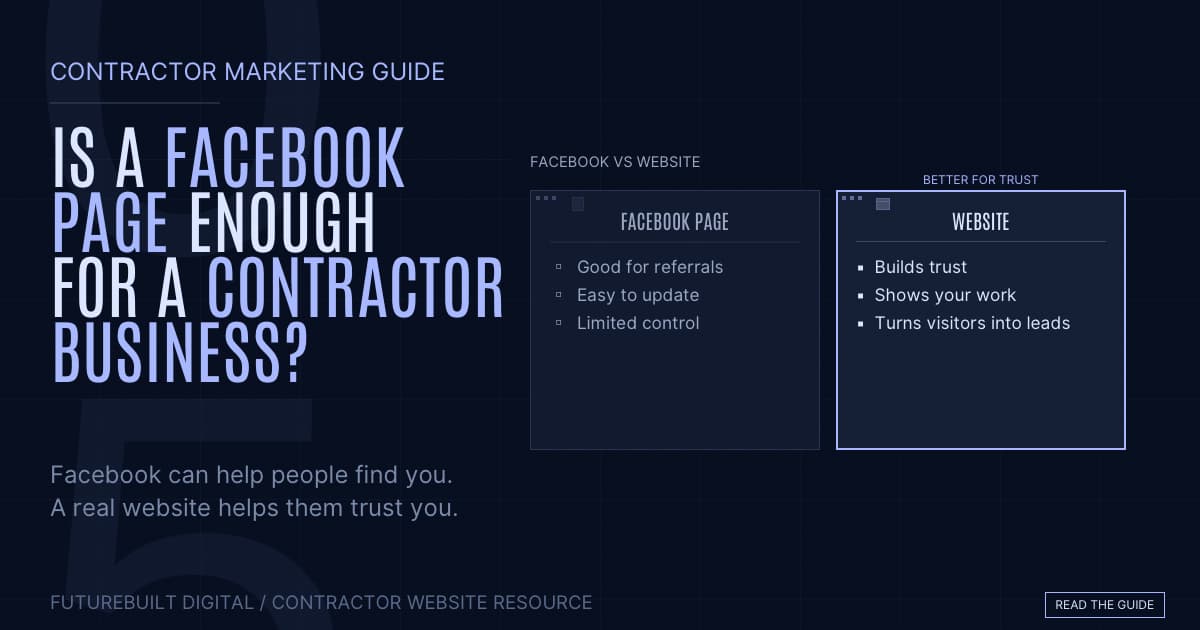
Is a Facebook Page Enough for a Contractor Business?
A Facebook page can help a contractor business get attention.
It can help you post project photos, get tagged in local groups, answer quick questions, and stay visible with past customers. For a new contractor or small local service business, that can be a practical place to start.
But a Facebook page is not a full replacement for a contractor website.
Facebook helps people discover your business. A website helps them verify it, understand it, and take the next step without scrolling through old posts or sending a social media message.
For most contractors, the strongest setup is not Facebook instead of a website. It is Facebook for visibility, Google Business Profile for local discovery, and a website for trust, service details, and quote requests.
The short answer: Facebook helps people find you, but a website helps them verify you
A Facebook page may be enough for now if you are brand new, referral-only, or not trying to grow beyond your current workload.
But if you want homeowners to take you seriously, understand your services, see proof of your work, and contact you with less friction, a website usually matters.
The website does not need to be large. It needs to answer the questions homeowners already have:
- What services do you offer?
- Do you work in my area?
- Can I see examples of your work?
- Do you look legitimate?
- How do I request a quote?
Research on local business behavior shows that consumers pay close attention to contact information, reviews, accurate business details, and whether a business looks trustworthy across different places online. source: BrightLocal, Consumer Search Behavior 2025
That is where a Facebook-only setup can start to feel limited.
Facebook can start the conversation. Your website should make the next step easy.
What Facebook is actually good at for contractors
Facebook is not useless. For many contractors, it is one of the easiest places to stay visible.
A Facebook page can work well for:
- Posting recent project photos
- Getting tagged in local recommendation threads
- Sharing seasonal reminders
- Showing that your business is active
- Answering quick questions through Messenger
- Staying in front of past customers
- Getting shared in neighborhood or community groups
This matters because contractors often grow through relationships and referrals.
A roofer might post storm repair photos after a bad weather week. A landscaper might share before-and-after cleanup photos. A pressure washing business might post a driveway transformation. A remodeler might share progress photos from a bathroom project.
Those posts can create attention and start conversations.
Contractor website note: Facebook is useful for attention. The problem starts when it is the only place a homeowner can check your business.
For some contractors, Facebook also feels easier than a website. You can post from your phone, answer messages quickly, and show recent work without learning a new platform.
That is a real advantage.
But easy does not always mean complete.
Where Facebook falls short
Facebook is built around posts, comments, shares, reactions, and messages.
That works for social activity. It does not always work as well for a homeowner who is trying to make a confident hiring decision.
A homeowner looking for a contractor usually wants practical answers quickly. They want to know what you do, where you work, whether your business looks legitimate, and how to contact you.
On Facebook, those answers are often scattered.
It is not organized around homeowner questions
Important information can get buried on a Facebook page.
Your best project photo might be twenty posts down. Your service area might be mentioned in an old caption. Your quote process might not be clear. Your phone number may be listed, but the visitor may still have to scroll to understand which services you offer.
That creates friction.
A homeowner should not have to dig through months of posts to find out whether you handle roof repairs, AC replacement, kitchen remodeling, concrete patios, or pressure washing.
A contractor website gives those answers a clear home.
It is weaker as a long-term trust hub
Facebook can show activity, but trust is often scattered across posts, comments, reviews, photos, and messages.
A website lets you organize trust signals more clearly:
- Services
- Service areas
- Project examples
- Reviews or testimonials
- Licensing or insurance information when relevant
- Contact details
- Quote request options
- Process details
- Warranty or workmanship notes when applicable
Research on home service customers shows that homeowners care about service reputation, proof of completed work, and a professional website experience. source: Housecall Pro, 2025 Home Service Customer Service Report
Facebook can still help. Your website simply makes the proof easier to find.
It does not give you the same control as your own website
Facebook controls the layout. Facebook controls how people interact with the page. Facebook decides how posts appear, how old content is found, and how much of the experience you can customize.
Your website gives you more control over the path a visitor takes.
You can decide what they see first. You can organize services clearly. You can place quote buttons where they make sense. You can create pages for specific services or locations. You can connect the website to your Google Business Profile, business cards, vehicle graphics, emails, and follow-up messages.
That control matters more as your business grows.
Facebook Page vs Google Business Profile vs website
For contractors, this should not be treated as a simple Facebook versus website decision.
Each platform does a different job.
| Need | Facebook Page | Google Business Profile | Contractor Website |
|---|---|---|---|
| Local visibility | Good through posts, shares, and local groups | Strong for Google Search and Maps | Supports local SEO and branded search |
| Project photos | Good for recent updates | Useful for quick proof | Best for organized galleries and examples |
| Reviews | Limited and platform-specific | Strong | Can showcase selected proof |
| Service details | Often scattered | Helpful, but limited | Strong |
| Service area | Can be unclear | Strong when set up well | Strong and explainable |
| Quote requests | Usually Messenger-based | Calls, clicks, quote actions | Forms, buttons, and clear next steps |
| Control | Limited | Limited | Strong |
| Long-term asset | Platform-dependent | Platform-dependent | Owned business asset |
A Facebook page can help people hear about you.
A Google Business Profile can help people find you in Google Search and Maps.
A website helps people understand why they should contact you.
Google’s Business Profile documentation shows that profiles can drive customer interactions such as calls, website clicks, directions, bookings, and quote requests. source: Google, Understand your Business Profile performance
That means your website and Google profile should work together, not compete.
For contractors who want a clearer online presence, a dedicated contractor website gives your services, proof, service area, and quote request path a more reliable home.
Why referrals still lead back to Google
Many contractors think of referrals as separate from online marketing.
They are not as separate as they used to be.
A homeowner might hear your name from a neighbor, see your work in a Facebook group, or get your number from a past customer. Before they call, they may still search your business name, check reviews, look for photos, confirm your service area, or see whether you have a real website.
That does not mean the referral failed. It means the homeowner is doing normal due diligence.
Roofing industry research found that homeowners commonly rely on word-of-mouth referrals and recommendations, but internet search and online reviews also play important roles in how they evaluate contractors. source: Roofing Contractor, 2025 Homeowner Roofing Survey
Here is a common example.
A storm comes through the area. Someone asks for a roofer in a neighborhood Facebook group. Your company gets recommended. The homeowner clicks your Facebook page, then searches your business name on Google. They want to see reviews, service details, roof repair photos, licensing or insurance language, and a clear way to request an estimate.
If they find only a thin Facebook page and scattered posts, they may hesitate.
If they find a clean website with roof repair information, project examples, service area details, reviews, and a quote button, the referral feels stronger.
That is the role a website plays.
It supports the trust that referrals already started.
What a contractor website does that Facebook does not do as well
A contractor website does not need to be fancy. It needs to be useful.
The goal is not to impress people with design tricks. The goal is to answer the questions that stand between interest and contact.
It gives every service a clear place
Many contractors offer several services.
A roofer may handle:
- Roof replacement
- Roof repair
- Storm damage
- Gutters
- Inspections
An HVAC company may handle:
- Furnace repair
- AC replacement
- Maintenance
- Indoor air quality
- Emergency service
A remodeler may handle:
- Bathrooms
- Kitchens
- Basements
- Flooring
- Interior updates
On Facebook, those services may be mentioned across different posts. On a website, they can be organized in one place.
That makes it easier for a homeowner to confirm that you handle the job they need.
It makes proof easier to find
Project photos are powerful for contractors.
But when all of your photos live only in a Facebook feed, the best examples can disappear under new posts, comments, shared content, and updates.
A website can organize proof by service or project type.
For example:
- A roofer can show roof replacements, repairs, gutters, and storm damage work.
- A remodeler can separate bathrooms, kitchens, basements, and flooring.
- A landscaper can show cleanups, patios, planting, and seasonal maintenance.
- A pressure washing business can show driveways, siding, decks, and commercial work.
Home service research shows that homeowners value proof of completed work, including photo or video proof. source: Housecall Pro, 2025 Home Service Customer Service Report
Facebook can still be part of that. Your website gives the best proof a more permanent home.
It gives quote requests a cleaner path
A good contractor website should make the next step obvious.
That usually means clear buttons like:
- Request a Quote
- Contact Us
- Schedule an Estimate
- Ask About a Project
The form should be simple. Most contractors do not need a long intake form for the first contact. They need enough information to start the conversation:
- Name
- Phone or email
- Service needed
- Project location
- Short message
- Optional photo upload if relevant
When the quote path is clear, the visitor does not have to guess what to do next.
It supports your Google profile and referral traffic
Your website gives you a stable link to use across your business.
You can use it on:
- Google Business Profile
- Business cards
- Truck or trailer graphics
- Yard signs
- Emails
- Text message referrals
- Google Ads
- Local directories
- Follow-up messages
That makes your marketing more connected.
A referred homeowner can land on the website. A Google visitor can click through from your Business Profile. A Facebook visitor can move from a project post to a quote form. A past customer can send your link to a neighbor.
You can see how a clean contractor website can be structured by viewing an example site.
Need something simple, professional, and built to get quote requests?
If you’re a contractor relying on Facebook, referrals, or your Google profile, a clean website can give homeowners a clearer place to understand your services and contact you. FutureBuilt Digital builds clean, mobile-friendly websites for contractors and local service businesses. Standard builds start at $1,200.
Request a Quote
When Facebook might be enough for now
A website is not always the first thing every contractor needs.
Facebook might be enough for now if:
- You are just starting the business
- You are still testing which services you want to offer
- Most of your work comes from direct referrals
- You are booked out and not trying to grow
- You mainly work as a subcontractor
- You are not ready to invest in a professional site
- You only need a simple place to post updates and photos
That is a real stage for many small contractors.
The issue comes when the business starts to outgrow that setup.
If you want to look more established, support your Google Business Profile, organize proof, explain your services, or create a better quote request process, a website starts to matter more.
Contractor website note: A website does not replace referrals. It gives referred homeowners a better place to confirm they are making a good decision.
Signs you have outgrown a Facebook-only setup
You may not need a large website. But you may have outgrown a Facebook-only setup if these problems keep showing up:
- People ask what services you offer
- People ask what areas you serve
- You keep sending the same project photos manually
- You rely on Messenger for every inquiry
- You want a better link for your Google Business Profile
- You want your business to look more established
- You are considering Google Ads
- You want referrals to land somewhere more professional
- You spend too much time answering basic questions
- You have good project photos, but no organized place to show them
- You want to explain your process before the first call
- You want a cleaner way to collect quote requests
These are not just website problems. They are sales problems.
If people are interested but confused, your website can help remove some of that friction.
What a simple contractor website should include
A good contractor website does not need dozens of pages.
For many small contractors and local service businesses, a focused 5-page website can cover the basics well.
| Website section | Why it matters |
|---|---|
| Homepage | Explains who you help, what you do, and what to do next |
| Services page | Helps homeowners confirm you handle their job |
| Service area section | Shows where you work |
| Gallery or examples | Gives proof of completed work |
| Reviews or testimonials | Reduces hesitation |
| Contact or quote page | Makes the next step clear |
| About section or page | Helps the business feel real and established |
The goal is not to make the website huge. The goal is to make it useful.
A homeowner should be able to land on your site and quickly understand:
- What kind of work you do
- Whether you serve their area
- Whether your business looks trustworthy
- How to request a quote
That is the core job of a contractor website.
How Facebook, Google Business Profile, and your website should work together
The best setup is usually not one channel.
It is a simple system.
Use Facebook for:
- Recent project photos
- Community visibility
- Local conversations
- Seasonal updates
- Customer comments
- Staying active with past customers
Use Google Business Profile for:
- Local search visibility
- Reviews
- Calls
- Directions
- Website clicks
- Service area information
- Business updates
Use your website for:
- Clear service information
- Organized project examples
- Service area details
- Quote requests
- Business credibility
- A stable link you can use anywhere
The key is consistency.
Your phone number, service area, business name, website link, and basic details should match across Facebook, Google Business Profile, your website, and other listings. Local consumer research shows that people often check whether business information matches across different places online. source: BrightLocal, Consumer Search Behavior 2025
When those details are inconsistent, it can create doubt.
When they match, your business feels easier to trust.
The strongest setup is not Facebook or website. It is Facebook for attention, Google for local discovery, and your website for trust and quote requests.
Bottom line
A Facebook page can help a contractor business, especially for referrals, project updates, local visibility, and quick conversations.
But it should not be the only online home for a contractor who wants to look established, support Google discovery, organize proof, and make quote requests easier.
Facebook is good for activity.
Google Business Profile is important for local discovery.
A website is where your services, proof, service area, and quote path can come together in one place.
If your business is brand new, Facebook may be enough for now. But if homeowners are already checking you online, comparing you with other contractors, or asking basic questions before they contact you, a simple website can make your business easier to understand and easier to trust.
The website does not need to be complicated. It needs to be clear, mobile-friendly, and built around the questions homeowners ask before they call.
Need a contractor website that actually helps people trust you?
FutureBuilt Digital builds clean, mobile-friendly websites for contractors and local service businesses, built to turn visitors into quote requests.
Related guides
Contractor Websites 7 min read
The Contractor Website Checklist: 12 Things Your Site Needs to Turn Visitors into Leads
If your website is missing any of these 12 things, it may be costing you calls and quote requests every week. A practical guide for contractors.
Read the articlearrow_forwardContractor Websites 6 min read
How Much Should a Contractor Website Cost?
A practical guide for contractors comparing cheap website builders, freelancers, agencies, and custom-built service business websites.
Read the articlearrow_forward