
Why Homeowners Do Not Trust Some Contractor Websites
Learn why homeowners hesitate on contractor websites and what trust signals can make your business easier to contact.
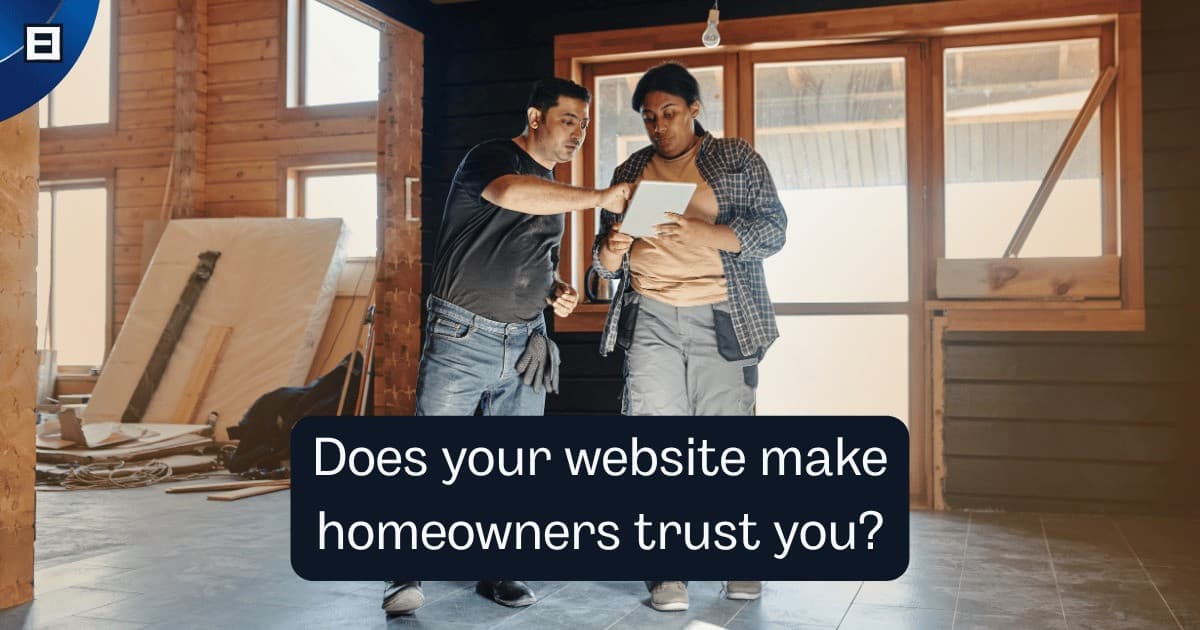
A homeowner does not land on a contractor website for entertainment. They have a problem they want fixed.
Maybe the roof is leaking. Maybe the AC stopped working. Maybe the driveway is cracked, the siding looks rough, or the kitchen remodel has been sitting on the to-do list for years. They found your name through Google, a referral, Facebook, or your reviews. Now they are checking your website before deciding whether to call.
That visit is a trust test.
Your website does not need to look expensive to pass that test. It needs to look real, current, local, and easy to contact. If the site creates doubt, the homeowner may leave without ever telling you why.
Reviews may get the click. Your website still has to earn the call.
Research on local business behavior shows that many consumers continue researching after reading reviews, and many visit a business website after reading positive reviews. source: BrightLocal 2026 Local Consumer Review Survey Home service research also shows that homeowners often begin their search online and expect a professional digital experience. source: ServiceTitan Consumer Trends Report source: Housecall Pro Home Service Customer Service Report
This article explains why some contractor websites lose trust and what to fix first.
Homeowners Use Contractor Websites as a Risk Filter
Hiring a contractor can feel risky for a homeowner.
They may be inviting someone into their home, spending serious money, and trusting that the job will be done safely and correctly. Before they call, they want to lower that risk.
Your website helps them answer questions like:
- Are you a real business?
- Do you handle the exact service I need?
- Do you work in my area?
- Can I see proof of completed work?
- Do other homeowners trust you?
- Will you respond?
- Is it easy to request a quote?
If your website answers those questions clearly, the next step feels easier. If it does not, the homeowner may keep searching.
Contractor website note: Homeowners usually do not need to be impressed before they call. They need to feel safe enough to take the next step.
This is why trust matters as much as design. A simple contractor website can work well when it shows clear services, real proof, a service area, and an obvious contact path. A polished site can still fail if it feels vague, generic, or hard to use.
Why Reviews Alone Are Not Enough
Good reviews matter. A strong Google review profile can help a homeowner notice your business, compare you with other contractors, and feel more comfortable clicking through.
But reviews are not always the final step.
Many homeowners use reviews as a starting point, then visit the contractor’s website to confirm what they saw. source: BrightLocal 2026 Local Consumer Review Survey That is where trust can either get stronger or fall apart.
Picture this: a homeowner reads several strong reviews for a roofing company. Then they click the website and see no real project photos, no clear service area, a vague headline like “Quality you can trust,” and a quote form that gives no idea what happens next.
The reviews helped get the visit. The website made the homeowner hesitate.
A good contractor website should support the trust your reviews created. It should show that the business is active, capable, local, and easy to contact.
You can see how a cleaner contractor website can organize services, proof, and quote requests on the FutureBuilt example site.
The Website Mistakes That Make Homeowners Hesitate
Most contractor websites do not lose trust because of one huge mistake. They lose trust through small doubts that stack up.
The site feels outdated. The services are unclear. The photos look generic. The quote button is buried. The phone number is not easy to tap. The service area is missing. The contact page asks too much and explains too little.
Each issue adds friction.
1. The site looks neglected
An older website is not automatically a bad website. Some simple sites still build trust because they show a real address, years in business, licensing information, project photos, and clear contact details.
The problem is when a site looks neglected.
Common signs include:
- Broken links
- Outdated footer dates
- Old blog posts that make the site feel abandoned
- Template text that was never removed
- Duplicate headings
- Low-quality images
- Cluttered navigation
- Pages that do not work well on a phone
Website credibility research has found that visual design and look-and-feel affect how people judge credibility. source: Stanford Web Credibility Guidelines For contractors, that does not mean the site has to be fancy. It means the site should not make the business look careless.
2. The site does not say what you do clearly
Many contractor websites use broad headlines that sound nice but do not help the visitor.
Weak headline:
“Quality Service You Can Trust”
Better headline:
“Roof Repair and Replacement for Homeowners in Chicago”
The second version works harder because it answers two questions right away: what you do and where you work.
That matters because homeowners scan quickly. They are trying to confirm they are in the right place. A vague headline makes them do the work.
Clear service and location language is especially important for contractors because many homeowners search by job type and area. They are not just looking for “quality.” They are looking for “AC repair near me,” “roof leak repair in Chicago,” “concrete patio contractor,” or “pressure washing service in my area.”
3. The site does not show enough proof
A contractor can make strong claims on a website, but homeowners want evidence.
Real proof can include:
- Project photos
- Before-and-after images
- Reviews or testimonials
- Job locations or service areas
- Certifications where relevant
- Licensing and insurance information where appropriate
- Warranty or guarantee language
- A short explanation of the work process
Photo and video proof is becoming more important in home services. Housecall Pro research found that many homeowners expect photo or video proof of completed work. source: Housecall Pro Home Service Customer Service Report
That does not mean every contractor needs a huge gallery. Even a few real photos can make a site feel more grounded than a set of generic stock images.
Stock photos are not always wrong. They can help fill visual gaps. But if every image looks like it came from a template, the site may not feel tied to a real crew, real jobs, or a real service area.
4. The next step is hard to find
When a homeowner is ready to contact you, the website should not make them hunt.
Common contact problems include:
- Phone number hidden in the footer
- Quote button missing from the top of the page
- Contact form that is too long
- No click-to-call button on mobile
- No explanation of what happens after submitting the form
- No service area reminder near the contact section
- No backup contact option
Mobile experience matters here. Google’s mobile-speed research has found that slow mobile pages can cause visitors to abandon a site before taking action. source: Google, The Need for Mobile Speed
A contractor website should make the next step obvious. Call, request a quote, ask a question, or view an example. The visitor should never have to guess.
| Website issue | What the homeowner may think | What to fix |
|---|---|---|
| No real project photos | “Have they done work like mine?” | Add recent job photos, before-and-after images, or a simple gallery |
| Vague headline | “Do they handle my problem?” | Use a service + location headline |
| No service area | “Do they work in my town?” | Add cities, neighborhoods, or service-area details |
| Hidden phone number | “This will be a hassle” | Make phone and quote buttons visible on mobile |
| Stock-heavy design | “Is this a real company or just a template?” | Replace generic images with actual work and team photos |
| Old footer or broken links | “Is this business still active?” | Remove outdated elements and check links |
| Long contact form | “This is too much work” | Ask only for the information needed to start the conversation |
Need a contractor website that makes your business easier to trust?
FutureBuilt Digital builds clean, mobile-friendly websites for contractors and local service businesses. Standard builds start at $1,200.
Get a Website Quote
What Homeowners Want to See Before They Contact You
A trust-building contractor website does not need to overwhelm the visitor. It needs to answer the right questions in the right places.
The strongest trust signals are usually simple.
Clear services and locations
A homeowner should quickly understand what you do and where you work.
For example, a roofer should make roof repair, replacement, storm damage, leak repair, and service areas easy to find. An HVAC company should separate repair, installation, maintenance, emergency service, and financing where relevant. A pressure washing company should list house washing, driveway cleaning, deck cleaning, and commercial work if offered.
Do not make people piece together your services from scattered paragraphs. Clear service structure helps homeowners feel confident that you handle their specific problem.
For broader contractor website structure, see Chicago contractor websites.
Real proof of work
Real photos are one of the fastest ways to make a contractor website feel believable.
They do not have to be perfect. A clear phone photo of a finished roof, cleaned driveway, installed furnace, remodeled bathroom, or completed patio can often feel more trustworthy than a polished stock image.
Good proof sections can include:
- A small homepage gallery
- Before-and-after photos
- A project page
- A service-specific photo section
- Captions that explain the work
- Photos tied to service areas or job types
Google’s Business Profile photo guidance encourages real business photos that represent reality. source: Google Business Profile photo guidelines
The goal is not to make the site look like a magazine. The goal is to help the homeowner think, “They have done this kind of work before.”
Contact options that feel easy
The contact path should feel low-friction.
A strong contractor contact section usually includes:
- Click-to-call phone number
- Short quote form
- Service type field
- City or ZIP code field
- Simple message field
- Clear button text
- Optional response expectation
- Reminder of service area
A form does not need to ask for every detail. It only needs enough information to start the conversation.
Weak button text:
“Submit”
Better button text:
“Request a Quote”
Even small wording choices can make the next step feel clearer.
Contractor website note: Trust signals should not be buried at the bottom of the page. If a homeowner has to scroll too far to feel safe, the page is making trust harder than it needs to be.
Trade-Specific Trust Problems
Contractor website trust is not exactly the same in every trade. A roofer, HVAC company, remodeler, cleaner, landscaper, and concrete contractor may all need proof, but the homeowner’s concerns are different.
Roofing websites
Roofing is often urgent. A homeowner may be dealing with leaks, storm damage, missing shingles, or insurance questions.
A roofing website should make roof repair, roof replacement, leak repair, service areas, project photos, reviews, and the quote path easy to find. If emergency or urgent service is offered, that should be clear too.
For roofing-specific website help, see Chicago roofing websites. You can also view the Lakefront Roofing example site.
HVAC websites
HVAC issues can become urgent during extreme heat or cold. Homeowners want to know whether the company can respond, what services are available, and how to contact someone quickly.
An HVAC website should make AC repair, furnace repair, installation, replacement, maintenance, emergency service, phone access, and scheduling clear. If financing or pricing guidance is available, it should not be buried.
For HVAC-specific structure, see HVAC websites.
Remodeling websites
Remodeling usually involves more planning, more money, and more trust.
A remodeling website should show project photos, types of remodels, process steps, timeline expectations where possible, service areas, testimonials, and a clear consultation path.
A remodeler does not need to show every job ever completed. But the site should give the homeowner enough confidence to start a conversation.
Cleaning and pressure washing websites
Cleaning and pressure washing customers often care about convenience, reliability, safety, and clear quote expectations.
Strong trust signals include an easy request form, clear service list, before-and-after photos, satisfaction guarantee if offered, service area, recurring service options, and a simple explanation of what is included.
Concrete and landscaping websites
For concrete and landscaping, homeowners want to see finished work.
Useful trust signals include photos of patios, driveways, sidewalks, retaining walls, lawns, or hardscapes, plus service-area examples, project types, process notes, licensing or insurance information where relevant, and a clear estimate path.
The more visual the work is, the more important real photos become.
A Quick Contractor Website Trust Audit
You do not need to redesign your whole website to spot trust problems.
Start with this checklist:
- Does your homepage say what you do and where you work within the first few seconds?
- Is your phone number visible on mobile?
- Is there a clear quote or contact button near the top of the page?
- Do you show real project photos?
- Do you show reviews, testimonials, or other proof?
- Is your service area easy to find?
- Are your services written in plain language?
- Does your contact form feel simple?
- Do you explain what happens after someone reaches out?
- Are old dates, broken links, and template leftovers removed?
- Does the site load quickly on a phone?
- Does the site feel like a real contractor business, not a generic template?
Contractor website note: A trust audit is not about finding every design flaw. It is about finding the moments where a homeowner might hesitate.
If several of these items are missing, your website may not be giving visitors enough confidence to contact you.
What to Fix First
Some contractor websites need a rebuild. Others just need a sharper structure, better proof, and a clearer contact path.
Start with the fixes that remove the most doubt.
Fix the headline first
Your homepage headline should not be clever. It should be useful.
Weak:
“Built on Quality and Trust”
Better:
“Concrete Driveways and Patios for Homeowners in the Chicago Area”
The better version tells the homeowner what you do and where you work. That is usually more valuable than a broad slogan.
Fix the mobile quote path
Open your website on your phone and ask:
- Can I tap the phone number easily?
- Can I find the quote button without searching?
- Does the form fit the screen?
- Is the page slow?
- Does anything feel broken or cramped?
Many homeowners will see your site on a phone first. If mobile is frustrating, trust drops before the conversation starts.
Add real proof
Add proof close to where people make decisions.
Useful proof includes review snippets near CTAs, project photos near service sections, service-area examples, certifications or licenses where relevant, before-and-after images, and short process explanations.
Do not bury all proof on one page that visitors may never click.
Simplify the contact form
A good quote form should be easy to complete.
For many contractors, the basics are enough:
- Name
- Phone or email
- Service needed
- City or ZIP code
- Short message
- Optional photo upload if useful
You can collect more details later. The first job of the form is to start the conversation.
Remove signs of neglect
Small details matter because they signal whether the business pays attention.
Look for broken links, old dates, outdated badges, duplicate sections, placeholder text, low-quality images, thin pages, services you no longer offer, and cities you no longer serve.
A homeowner may not notice every detail, but they notice the feeling those details create.
| Priority | Fix | Why it matters |
|---|---|---|
| First | Clear service + location headline | Helps homeowners know they are in the right place |
| Second | Mobile phone and quote button | Makes the next step easy |
| Third | Real project proof | Reduces doubt |
| Fourth | Service area details | Helps local visitors confirm fit |
| Fifth | Short quote form | Reduces friction |
When a Website Rebuild Makes More Sense Than Patching
Not every contractor needs a new website.
If your site is basically sound, you may be able to improve trust by updating photos, clarifying your services, cleaning up your contact path, and adding stronger proof.
A rebuild may make more sense when the site is not mobile-friendly, the design looks abandoned, the navigation is confusing, the copy is generic across every page, the contact form is weak or broken, services are missing, or the site is hard to update.
The point of a rebuild should not be to make the site complicated. It should be to make the business easier to understand, easier to trust, and easier to contact.
FutureBuilt Digital builds clean, mobile-friendly websites for contractors and local service businesses. Standard builds start at $1,200. You can request a website quote here.
Final Recommendation
Homeowners do not need your contractor website to be flashy.
They need it to answer the questions that make them comfortable enough to call:
- What do you do?
- Where do you work?
- Can I see proof?
- Do other people trust you?
- Is your business active and local?
- What happens after I contact you?
Trust comes from clarity, proof, and ease of contact. A simple website can do that well. A confusing website can lose the opportunity before you ever know the homeowner visited.
Trust comes from clarity, proof, and ease of contact, not from looking expensive.
Start by fixing the obvious trust leaks: vague headlines, missing photos, unclear service areas, hidden contact buttons, long forms, and outdated content.
Those changes can make your website feel less like a brochure and more like a useful part of your sales process.
Need a contractor website that actually helps people trust you?
FutureBuilt Digital builds clean, mobile-friendly websites for contractors and local service businesses, built to turn visitors into quote requests.
Related guides
Contractor Websites 7 min read
The Contractor Website Checklist: 12 Things Your Site Needs to Turn Visitors into Leads
If your website is missing any of these 12 things, it may be costing you calls and quote requests every week. A practical guide for contractors.
Read the articlearrow_forwardContractor Websites 6 min read
How Much Should a Contractor Website Cost?
A practical guide for contractors comparing cheap website builders, freelancers, agencies, and custom-built service business websites.
Read the articlearrow_forwardContractor Websites 6 min read
Why Roofing Websites Lose Leads Before Homeowners Ever Call
A practical resource for roofers on the website issues that create hesitation before a homeowner calls or requests a quote.
Read the articlearrow_forward