
Why Roofing Websites Lose Leads Before Homeowners Ever Call
A practical resource for roofers on the website issues that create hesitation before a homeowner calls or requests a quote.
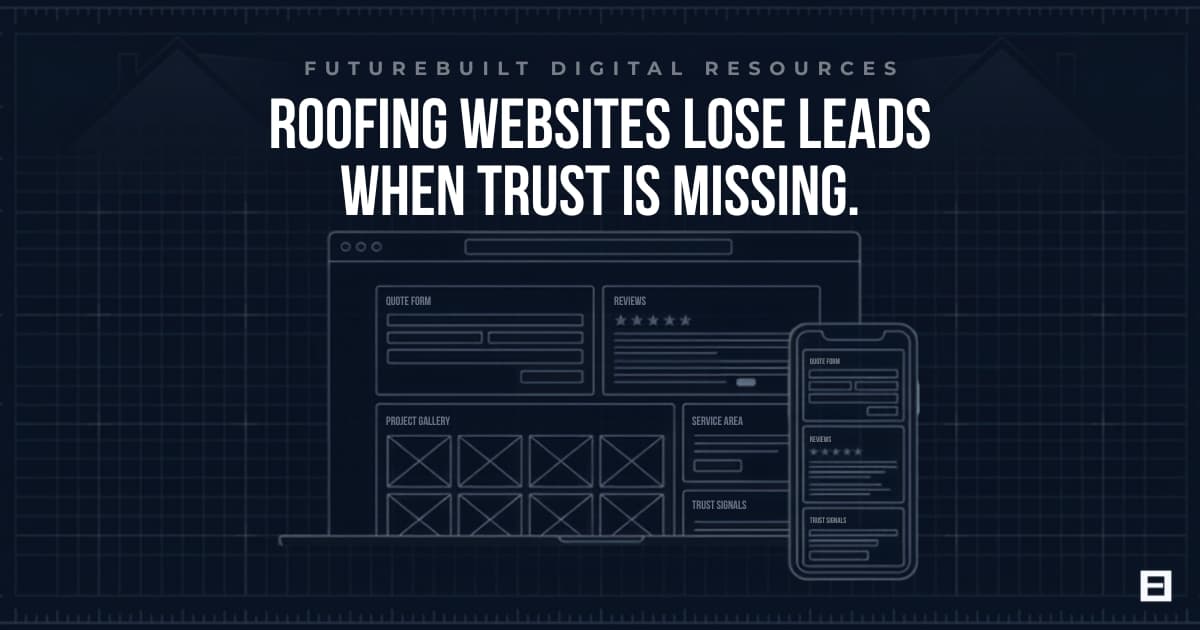
Why Roofing Websites Lose Leads Before Homeowners Ever Call
A roofing website does not usually lose a lead because it is not fancy enough.
It loses the lead when a homeowner lands on the site and cannot quickly decide whether the company is the right fit.
That homeowner may have a ceiling stain, missing shingles, storm damage, or an older roof they know needs attention. They are not browsing roofing websites for fun. They are trying to answer a few practical questions before they call.
Do you handle this kind of roofing problem?
Do you work in their area?
Do you look trustworthy enough to invite onto their property?
If your website makes those answers hard to find, the homeowner may leave without ever telling you what went wrong.
A roofing website loses leads when it creates hesitation
Most roofers think about their website from the business side. They want it to look professional, explain their services, and bring in calls.
Homeowners see it differently. They are screening you.
They are looking for signs that you are real, local, experienced, responsive, and capable of handling their specific problem. That matters because roofing is not a casual purchase. A bad roofing decision can mean water damage, insurance headaches, wasted money, or repairs that need to be redone.
Homeowners are not grading your website. They are screening you.
This is why a roofing website can look decent and still lose leads. The issue is not always design by itself. The issue is doubt.
A good roofing website reduces doubt quickly.
Do you handle my problem?
A lot of roofing websites describe services in broad terms:
"Residential roofing."
"Quality roofing solutions."
"Roofing services you can trust."
Those phrases are not wrong, but they often do not answer the homeowner's real question.
A homeowner with a leak wants to know if you handle roof repairs. Someone with shingles in the yard after a storm wants to know if you handle storm damage. Someone comparing estimates wants to know if you do full roof replacements. Someone selling a house may need an inspection or documentation.
The website should not force people to translate contractor language.
A stronger roofing website clearly explains the actual problems the company handles. That might include roof repair, roof replacement, storm damage, roof inspections, emergency leaks, gutters, or commercial roofing, depending on what the business actually offers.
This does not mean every roofing company needs a huge website. It means the service structure should match how homeowners think.
A page that says "we do roofing" is weaker than a page that helps someone understand:
- What roof issues you repair
- When replacement may make more sense
- Whether you inspect storm damage
- How homeowners can request a quote
- What happens after they reach out
That kind of clarity helps homeowners feel like they are in the right place.
It also helps the website support more specific searches. A person searching for roof leak repair is in a different situation than someone researching full roof replacement. Your website should respect that difference.
Do you work in my area?
Service area confusion is one of the easiest ways to lose a roofing lead.
A homeowner may like your reviews, your photos, and your overall site, but still hesitate if they cannot tell whether you serve their town.
"Serving the surrounding area" sounds fine to the business owner. To the homeowner, it can feel vague.
A person in Oak Park, Evanston, Naperville, Joliet, or a nearby suburb may not assume a Chicago roofer serves them unless the website says so clearly. The same applies in any metro area. Homeowners want to know whether they are actually in range before they spend time calling or filling out a form.
That does not mean stuffing city names into every paragraph. It means making the service area easy to understand.
A roofing website can do this with a clear service area section, a list of key cities or towns, local project examples, map cues, or service pages for important locations. For a competitive local market, a page about Chicago roofing websites should also be built around the way real homeowners search and compare local roofers.
The goal is simple: no one should have to guess whether you work where they live.
Can I trust you enough to call?
This is the big one.
Roofing is a high-trust service. Homeowners are thinking about cost, workmanship, insurance, warranties, property damage, and whether the company will actually respond.
That is why vague trust language does not carry much weight.
Every roofer says some version of:
"We are reliable."
"We are professional."
"We care about quality."
"We put customers first."
Those statements may be true, but they are not proof.
Proof looks more concrete. It looks like real project photos, recent review snippets, warranty information, certifications, licensing or insurance language when applicable, local job examples, crew or truck photos, and a simple explanation of what happens after someone requests a quote.
Contractor website note: A homeowner does not need your website to brag. They need it to remove doubt.
Research on local business behavior consistently shows that homeowners and other consumers use reviews heavily when comparing local companies. Many people read reviews first, then visit the business website before deciding whether to contact the company. source: BrightLocal, Local Consumer Review Survey
That means the website has to back up the trust that reviews started to build.
A roofing website should make the company feel real. Not polished in a fake way. Real.
Show the kinds of roofs you work on. Show before-and-after photos when you have them. Mention the towns where projects were completed. Use review excerpts that sound specific, not generic. Explain whether you offer inspections, estimates, financing, warranties, or insurance-claim support, if those things are part of your process.
The more expensive or urgent the roofing problem feels, the more proof the homeowner needs before they call.
Want to see what a cleaner roofing website can look like?
View a sample roofing website built around trust, clear services, and quote requests.
View Example Site
The phone number and quote path are harder to find than you think
Some roofing leads want to call. Some want to fill out a quote form. A good website makes both paths easy.
This sounds obvious, but many roofing websites still hide the phone number in the footer, use a contact page that takes too much effort to find, or make the quote form feel like a full inspection report.
A homeowner with water coming through the ceiling may not want to fill out twelve fields before they know if you can help. They may want to tap a phone number from their mobile screen and talk to someone.
That does not mean quote forms are bad. A good quote form can help sort the request and collect useful details. But it should feel like the start of a conversation, not homework.
A practical roofing quote form might ask for the homeowner's name, contact information, address or service city, type of issue, and a short message. It can also allow photo uploads if that helps your process.
The site should also explain what happens next.
Something as simple as "Request a quote, schedule an inspection, and get a clear recommendation" can reduce hesitation. Homeowners are more likely to reach out when the next step feels predictable.
Mobile is not a separate version of the website
A lot of roofing website problems show up more clearly on a phone.
The desktop site might look fine. Then the mobile version stacks awkwardly, hides the phone number, shrinks the project photos, buries the quote button, or makes the service area hard to find.
That matters because many homeowners check a roofer from a phone. They may have received a referral by text. They may be looking after a storm. They may be comparing companies from Google Maps. They may have seen a truck in the neighborhood and searched the company name.
Google also uses the mobile version of a site's content for indexing and ranking, so mobile is not just a design preference. It affects how the site is understood and evaluated in search. source: Google Search Central, Mobile-first indexing best practices
But the practical point is even simpler.
On mobile, a homeowner should still be able to answer the same basic questions:
Do you handle my problem?
Do you work in my area?
Can I trust you?
How do I call or request a quote?
If those answers disappear on the phone version, the website is weaker than it looks.
A better roofing website is usually simple, not flashy
A roofing website does not need to feel like a national brand campaign. It needs to be clear, credible, and easy to use.
Here is a simple way to think about it:
| Homeowner question | Weak roofing website answer | Better website answer |
|---|---|---|
| Do you handle my problem? | "Quality roofing services" | Clear repair, replacement, inspection, and storm damage sections |
| Do you work in my area? | "Serving the surrounding area" | Specific cities, suburbs, counties, or local project examples |
| Can I trust you? | Stock photos and vague claims | Reviews, real photos, warranty details, certifications, and local proof |
| How do I contact you? | Hidden phone number or long form | Tap-to-call, clear quote button, simple request form |
| What happens next? | No explanation | Short process: request quote, schedule inspection, get recommendation |
The better version is not necessarily more complicated. In many cases, it is cleaner.
It removes filler. It organizes services around real homeowner problems. It puts proof where people actually need it. It makes the next step obvious without pushing too hard.
That is the difference between a website that only exists and a website that supports sales.
The ten-second homepage test
A roofer can learn a lot by looking at the homepage like a homeowner.
Open the site on a phone and give it ten seconds.
Can a homeowner tell what roofing problems you handle?
Can they tell whether you serve their area?
Can they see proof that you are a real, trustworthy company?
Can they call or request a quote without hunting?
Can they understand what happens after they reach out?
If the answer is no, the site may be creating hesitation before the sales conversation ever starts.
This does not always mean the whole website needs to be rebuilt. Sometimes the fix is clearer service copy, better project photos, a stronger quote section, or more visible local proof.
But if the site is outdated, thin, hard to use on mobile, missing key pages, or built around vague claims instead of homeowner questions, small edits may not be enough.
Final recommendation
A roofing website does not have to impress every visitor. It has to help the right homeowner feel confident enough to take the next step.
That starts with clarity.
Show what roofing problems you handle. Make the service area obvious. Prove that your company is real and trustworthy. Keep the phone number and quote path easy to find. Explain what happens after someone reaches out.
Most homeowners are not looking for the fanciest roofing website.
They are looking for a roofer they can trust with a problem they need solved.
Need a contractor website that actually helps people trust you?
FutureBuilt Digital builds clean, mobile-friendly websites for contractors and local service businesses, built to turn visitors into quote requests.
Related guides
Contractor Websites 7 min read
The Contractor Website Checklist: 12 Things Your Site Needs to Turn Visitors into Leads
If your website is missing any of these 12 things, it may be costing you calls and quote requests every week. A practical guide for contractors.
Read the articlearrow_forwardContractor Websites 8 min read
Why Homeowners Do Not Trust Some Contractor Websites
Learn why homeowners hesitate on contractor websites and what trust signals can make your business easier to contact.
Read the articlearrow_forward