Skip to content

Representative engagementIndustrial distribution

Automating RFQ intake without automating commercial judgment

Norwyn’s RFQs arrived as emails, PDFs and spreadsheets in no consistent format, and inside sales had to read, match and re-key each one before pricing could start. The original request was AI that writes the quote. Discovery showed the pricing data could not support it. Future Built automated the intake work in front of pricing and left price, terms and exceptions with the salespeople who hold that context.

Norwyn is a representative engagement, not a historical client. It shows how Future Built approaches RFQ intake. Company facts, measurements and results are constructed project data, economics are calculated from stated assumptions, and screens use synthetic data.

Engagement
AI-assisted RFQ intake
Duration
Six weeks
Role
Discovery, architecture, implementation, evaluation
The review screen for synthetic RFQ NMC-0261. The source email and PDF sit beside the extracted record, and a quantity conflict between them blocks CRM handoff until a person decides. Pricing does not appear on this screen.

The review screen for synthetic RFQ NMC-0261

Representative engagement · constructed project results

minutes of weighted intake effort per RFQ
17.2 → 5.57minutes of weighted intake effort per RFQ
intake hours a month, about 38 released
56.2 → 18.2intake hours a month, about 38 released
of RFQs routed to shortened review
82%of RFQs routed to shortened review
acknowledged within two business hours
37% → 88%acknowledged within two business hours

Summary

Norwyn, a 26-person industrial distributor, asked for software that could read an incoming RFQ, recognize the customer and produce a quote before a salesperson opened the email. Discovery found that customer pricing depended on negotiated multipliers and exceptions held in spreadsheets and salespeople’s heads. A model cannot price safely from that, so Future Built removed pricing from scope and targeted the 17 minutes of reading, matching and re-keying each RFQ needed first. Spreadsheets are parsed deterministically, eligible emails and PDFs go through bounded AI extraction, explicit rules set the level of review, and a salesperson confirms every record before it reaches HubSpot. In the representative model, monthly intake effort falls from 56.2 to 18.2 hours. Pricing stays with sales.

What discovery changed

The request treated quote drafting as the problem, so discovery first tested where the time actually went. Future Built reviewed 240 historical RFQs, observed a morning inbox triage, interviewed the sales manager, two inside reps, an outside rep and the controller, and traced where price, availability and customer terms came from.

Most of the repetitive effort came before price. Each email had to be recognized as an RFQ and tied to the right account. Attachments had to be opened, line items transcribed, requested dates found, duplicates caught, an owner chosen and a HubSpot record created. At 196 RFQs a month and 17.2 minutes each, intake consumed 56.2 hours a month before any pricing work started.

The pricing trace pointed the other way. List prices sat in supplier pricebooks, but what a customer actually paid often depended on negotiated multipliers, legacy account exceptions and vendor concessions held in spreadsheets, vendor portals or a salesperson’s memory. None of it was authoritative structured data. The bottleneck was intake, and the requested feature depended on the least reliable data in the business.
Defining the automation boundary

Four options were compared. An autonomous quoting agent was rejected because pricing authority was not machine-readable. A new CPQ platform was too large for the bottleneck and the budget. Simple email-to-CRM rules were too rigid for documents that change shape by customer. The selected design combined bounded extraction, deterministic validation and human review.

Everything left of the line prepares a structured RFQ. Everything right of it, including pricebooks, negotiated multipliers and margin exceptions, stays with the salesperson. Moving the line would first require an authoritative source for pricing rules.

Everything left of the line prepares a structured RFQ

The system owns operational preparation: receiving the email and preserving the source, routing attachments by format, parsing or extracting candidate values, validating them, matching the customer and building a review record. Once a person confirms the record, the system creates the HubSpot deal, assigns an owner and acknowledges receipt.

Salespeople and estimators keep everything commercial: price, margin exceptions, availability, account terms and the final quote.

An inconsistent document is a reading problem, and software can help read it. An undocumented pricing policy is a business problem, and a model would only guess at it.

Why pricing stayed out

The first technical spike did include automatic pricing from exported pricebooks, and it looked viable on simple list-price examples. It failed on the accounts where errors would cost the most: several large customers had negotiated multipliers and legacy exceptions that sales staff knew about but the export did not represent consistently.

No prompt could fix that; the missing information was not in any system the model could read. Future Built removed price calculation from production scope and documented why. The recommended next step is a separate discovery into centralizing account pricing rules: a data-governance prerequisite for any future quote automation.

The new RFQ workflow

Manual intake starts every request from zero. The assisted path prepares the data first, then spends human attention on confirmation and exceptions. In both versions, pricebooks, negotiated terms and commercial approval remain with people.

Manual intake starts every request from zero

Microsoft Graph signals each new message in a dedicated RFQ mailbox, and intake fetches the email and original attachments, deduplicates on message ID and retains the source package with hashes and source locations, so every value stays traceable.

A format router decides the path. XLSX and CSV files already contain rows and cells, so they are parsed and normalized deterministically and never sent to the language model; on structured input a parser is faster, cheaper and exact. Email bodies and text-based PDFs are normalized and passed to OpenAI structured extraction, which fills a defined RFQ schema with candidate values. Unsupported or unreadable files, including scanned drawings in phase one, go straight to manual intake.

Both paths feed the same validation. Candidates and validation issues are stored in Supabase Postgres with extraction runs, review events and an audit trail. The Next.js review queue reads that state, and only approved records sync to HubSpot, which remains the CRM of record.

Spreadsheets bypass the language model because a parser reads rows and cells exactly. Only eligible email and PDF text reaches bounded extraction, both paths converge on the same validation, and only approved records reach HubSpot.

Spreadsheets bypass the language model because a parser reads rows and cells exactly

Graph subscriptions are treated as operational dependencies rather than permanent plumbing: renewal is monitored, missed events can be reconciled, and notification failures surface to an operator. Replays retain the original message identity, so recovery does not create duplicate RFQs.

For the salesperson, the work shifts from opening, reading, transcribing and re-keying to inspecting, confirming and correcting where needed.

Managing uncertainty

Extracted values are untrusted candidates until they pass checks, and the model’s own sense of confidence never sets the route. Deterministic rules do: a supported, readable format; required fields present (part number or description, quantity, unit); a customer resolved by exact ID or approved alias; part numbers matching expected patterns. Field-level evidence, such as source agreement, can send a record to closer review but can never excuse a failed check.

Records that pass every check are auto-eligible, which here means a shortened human review. Useful extractions that fail a required check go to focused review. Unsupported, unreadable or materially ambiguous inputs go to full manual. Source conflicts block handoff until a person resolves them, missing values stay null rather than being invented, and every confirmed record is revalidated.

Explicit checks decide the route. Missing fields, uncertain evidence and source conflicts each lead to a different kind of human review, and every confirmed record is revalidated before it can reach the CRM.

Explicit checks decide the route

The evaluation design uses a 240-RFQ labeled set, stratified by customer and document format. In the constructed evaluation model, customer identity reaches 97.5%, part numbers 95.2% exact match on labeled lines, quantity and unit pairs 98.3%, and explicitly stated requested dates 96.7%. At the record level, the modeled route mix is 82% shortened review, 7% focused review and 11% full manual. These figures define the representative operating case; they are not a benchmark from a historical Norwyn deployment or a claim about OpenAI generally.

The representative rollout plan stages deployment: in week five, the system runs in shadow mode on live RFQs while two inside-sales reps compare its output with their own work; in week six, CRM creation and acknowledgment are enabled for the shortened-review route only.

The evaluation scores individual fields, then whole records, stratified by customer and document format. Its constructed outcomes determine how much review each route needs, and its failure taxonomy names what removes a record from the shortened path.

The evaluation scores individual fields, then whole records, stratified by customer and document format

A request in motion

The trace follows synthetic RFQ NMC-0261 from Alder Fabrication, shown in the review screen above. An email with a PDF arrives at 13:42:00 UTC and is deduplicated, fetched and routed a second later. Extraction takes 2.4 seconds and returns two typed line items with provenance.

Validation then catches something the model was never asked to settle. The PDF lists line 01, NX-PS18-PNP, at 12 EA, while the email body revises it to 24 EA. The validator raises SOURCE_CONFLICT and blocks handoff instead of picking a source silently. A reviewer opens the record at 13:44:00, compares both sources and corrects the quantity to 24 EA: 72 seconds, one correction. The record is revalidated, persisted with an audit event and queued for sync; HubSpot confirms it at 13:45:14, ready for human pricing.

One synthetic RFQ moves from mailbox to HubSpot in just over three minutes. The model extracts, the validator catches the 12-versus-24 quantity conflict and a reviewer resolves it. The record ends ready for human pricing.

One synthetic RFQ moves from mailbox to HubSpot in just over three minutes

Constructed project data

Operational impact

Post-launch figures cover a constructed eight-week period with all three inside-sales users on the queue. The headline figure weights the three routes: 82% of RFQs at 3.8 minutes, 7% at 8.0 minutes and 11% at the full manual 17.2 minutes, which gives 5.57 minutes per RFQ. At the same 196 RFQs a month, intake falls from 56.2 to 18.2 hours, releasing about 38 hours.

The case model gives high attribution to the effort reduction and to acknowledgment within two business hours, up from 37% to 88%. Median receipt to quote-ready handoff fell from 27.4 to 18.6 hours, and intake rework fell from 11.5% to 4.2%; both carry medium-to-high attribution.

At a modeled loaded cost of $45 an hour, the released time represents about $20,519 a year of employee capacity, not a payroll reduction. Against a $9,800 implementation, modeled payback is 5.7 months.

Same RFQ volume, less intake work. The 5.57-minute figure is a weighted mix of all three review routes rather than a best case, and the released hours are modeled capacity, not a measured payroll change.

Same RFQ volume, less intake work

What this demonstrates

The most valuable decision in this engagement came before the build. Norwyn’s RFQs were inconsistent but readable, so software could interpret them under explicit rules and human review. Its pricing authority was fragmented, so no model could act on it safely. Automating the first and leaving the second with people produced a smaller system with a stronger business case.

Built with

Microsoft Graph · OpenAI structured extraction · Supabase / Postgres · Next.js · HubSpot

All work
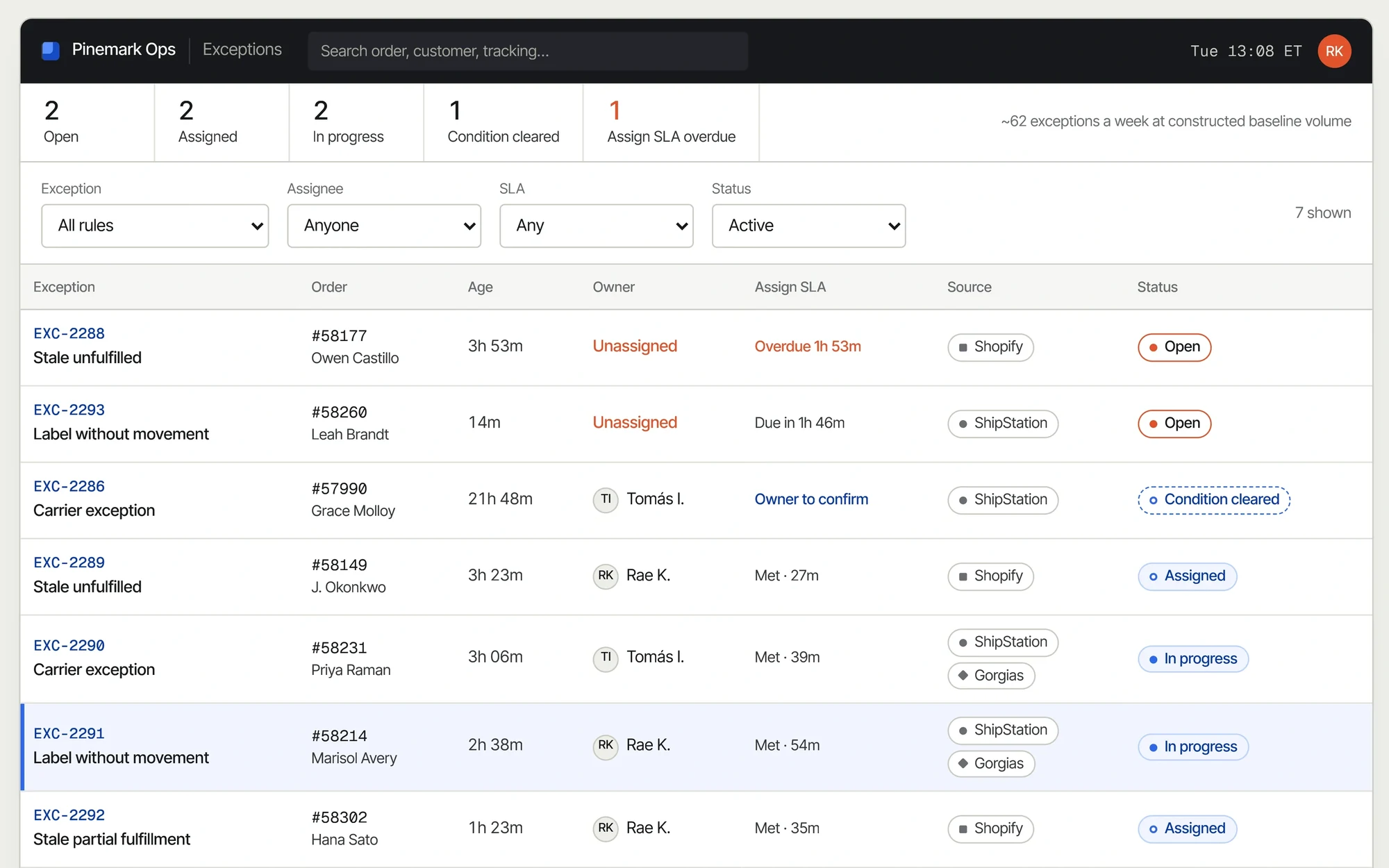
Pinemark exception queue with synthetic orders: counts by state, filters, and seven exceptions with rule, order, age, owner, assignment SLA, source systems and status.

Representative engagementEcommerce operations

Giving ecommerce exceptions a durable operational lifecycle

Another engagement that left existing systems of record in place, built deterministic operational state around them and made an early model failure part of the design story.

Time to owner 6h 12m → 1h 08m (constructed)

View case study
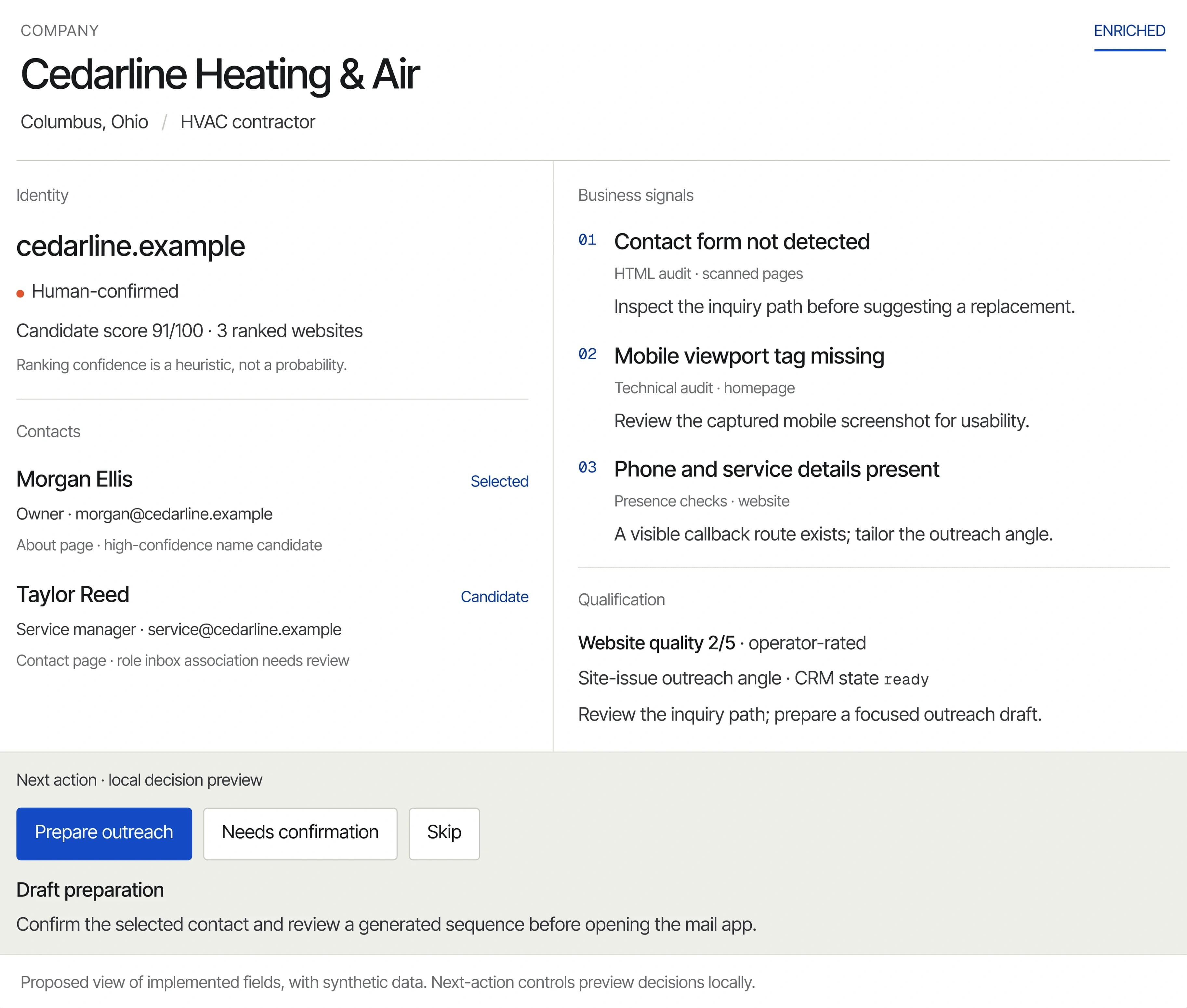
Lead workstation for synthetic record EX-1042, Cedarline Heating & Air, an HVAC contractor in Columbus, Ohio, marked Enriched. It shows the human-confirmed website cedarline.example with a candidate score of 91/100 across 3 ranked websites, two contacts (owner Morgan Ellis selected, service manager Taylor Reed as a candidate needing review), three site findings, an operator website-quality rating of 2/5 with CRM state "ready," and next-action buttons for Prepare outreach, Needs confirmation and Skip.

Internal systemLead intelligence

Scaling lead research without scaling manual research

The same principle at a different stage of the funnel: progressive automation that reserves human attention for the records where uncertainty actually matters.

173 operator hours a month released at 1,000 leads (modeled at $35/hour)

View case study